
If you’re standing at checkout wondering is Klarna or Afterpay better, the honest answer is: it depends on what you’re buying and how you plan to pay it off. Afterpay wins for small, everyday purchases you can clear in six weeks. Klarna wins when you need more time, more flexibility, or the ability to use buy now, pay later (BNPL) at a store that isn’t a direct partner.
Both apps let you split a purchase into smaller payments instead of paying the full price upfront. But 2026 has brought real changes to both companies — new corporate structures, new fee models, and a regulatory landscape that looks nothing like it did two years ago. Let’s break down exactly what’s different, and which app actually fits your wallet.
Which Is Better: Klarna or Afterpay? (The 2026 Executive Verdict)
Afterpay is better for small, everyday purchases you can repay in six weeks with zero interest and zero fuss. Klarna is better for larger purchases — electronics, furniture, travel — because it offers financing plans up to 36 months and a virtual card that works almost anywhere. If you shop mostly at big-box retailers and want simplicity, pick Afterpay. If you want flexibility across more stores and bigger budgets, pick Klarna.
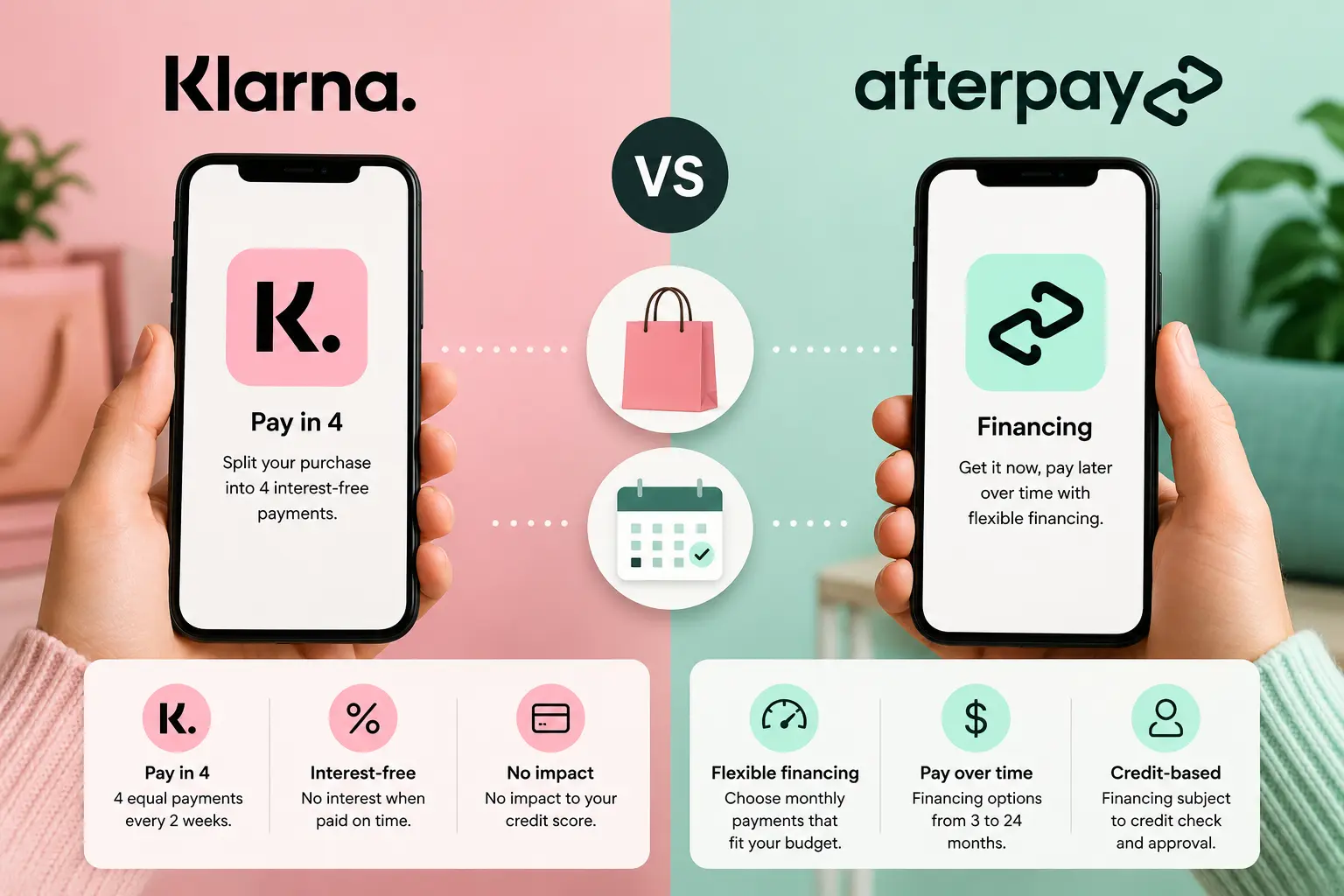
Both platforms use a Buy Now, Pay Later (BNPL) model. The core product on each — called Pay-in-4 — splits a purchase into four equal, interest-free installments spread over six weeks. Where they diverge is what happens beyond that basic structure: how big a purchase you can finance, what happens if you’re late, and how each company treats your credit report.
How Do Cash App Afterpay and Klarna Group plc Compare Today?
The 2026 landscape looks very different from a couple of years ago. Both companies went through major structural shifts that change how they operate — and what they can offer you.
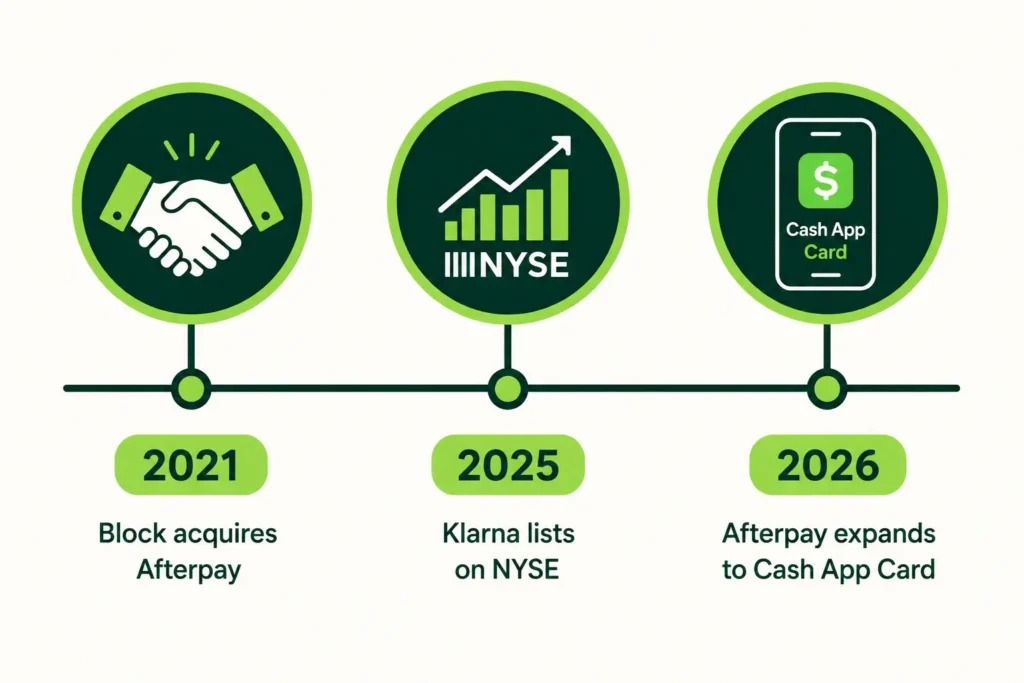
Klarna went public. The Swedish fintech completed its initial public offering of ordinary shares, with trading beginning on the New York Stock Exchange on September 10, 2025 under the symbol “KLAR.” As a publicly traded company, Klarna now faces quarterly earnings scrutiny, which has pushed it toward tighter underwriting standards — meaning it’s gotten more selective about who qualifies for larger financing plans, especially since the stock has been volatile since its debut.
Afterpay is now deeply woven into Cash App. Its parent company, Block, has spent the past two years merging Afterpay directly into the Cash App ecosystem. As of June 2026, Cash App announced the general availability of Afterpay on Cash App Card, bringing BNPL to eligible Cash App Card customers for any purchase, not just ones at partnered stores. This “Cash App Afterpay” experience uses near real-time data — cash flow patterns, spending habits, savings, and payment consistency — instead of looking backward at a traditional credit score to decide who qualifies.
That matters for readers: if you’re a Cash App user, you may now be able to use Afterpay-style financing anywhere Visa is accepted, not just at stores that have an Afterpay checkout button.
Soft Credit Inquiry vs. Hard Pull: Which App Impacts Your Credit Score?
This is one of the most common worries shoppers have, and the answer is more nuanced than most articles let on.
How Afterpay Avoids the Traditional Credit Bureau System
Afterpay’s standard Pay-in-4 doesn’t run a hard credit check, and it generally doesn’t report your payment history to the three major credit bureaus (Equifax, Experian, TransUnion) for its core installment product. That’s good news if you’re worried about a ding on your report, but it’s a double-edged sword: paying on time also won’t help you build credit.
When Klarna Triggers a Hard Credit Check
Klarna splits its products by risk level. Its Pay in 4 and Pay in 30 options use only a soft credit pull, which does not affect your credit score, and Klarna does not report those payments to the three major bureaus for credit-building purposes</cite>. It’s only when you step up to longer-term financing (6 to 36 months) that Klarna runs a hard inquiry, and those accounts do get reported to TransUnion and Experian as installment loans</cite>.
Bottom line: for everyday Pay-in-4 purchases, neither app helps or hurts your score under normal use. The credit risk only shows up on Klarna’s long-term financing plans, and on both apps, if a debt goes unpaid long enough to land in collections.
What Happens If You Miss a Payment on Klarna or Afterpay?
Missing a payment isn’t the same experience on both apps, and the differences matter a lot if you’re financially stretched.
What an Unpaid Afterpay Balance Actually Triggers
Contrary to what some comparison sites claim, Afterpay doesn’t hand out an instant “permanent ban.” What actually happens: if you miss a payment, Afterpay immediately pauses your account, and you can’t make new purchases until you’re caught up. On top of that, late fees are capped — they’ll never exceed 25% of the order total or $68 per order, whichever is lower. For orders under $40, that’s a single fee capped at 25% of the order. For larger orders, a $10 fee applies when the payment is missed, and an additional $7 fee kicks in if the balance is still unpaid after seven days . Repeated missed payments can shrink your spending limit or restrict your account longer-term, but it’s a graduated response, not an instant permanent lockout.
How Klarna Defaults Wind Up in Collections
Klarna handles it differently depending on the product. On Pay-in-4, a late payment triggers a fee — up to $7, and Klarna caps late fees at 25% of the purchase price. If the balance stays unpaid, Klarna can escalate the account, and unlike Afterpay, it can eventually sell the unresolved debt to a third-party collection agency. That collection account can then appear on your credit report, even though the original Pay-in-4 purchase never did. On Klarna’s longer financing plans, missed payments are reported directly to the bureaus since those accounts are tradelines from day one.
Practical takeaway: Afterpay’s consequence model is mostly access-based (you lose the ability to keep shopping with Afterpay). Klarna’s consequence model can eventually touch your actual credit file, particularly through collections or financing defaults.
Calculation Example: The Real Cost of a $1,200 Purchase
Numbers make this comparison real. Let’s say you’re financing a $1,200 laptop.
Afterpay Pay-in-4: You’d pay $300 at checkout, then three more payments of $300 every two weeks, for six weeks total. Cost if paid on time: $0 in interest or fees, total paid: $1,200. Miss a payment, and you’d be looking at a $10 fee, plus another $7 if it’s still unpaid a week later — capped well below the $68 order maximum since this order clears $40.
Klarna Pay in 4: Identical structure to Afterpay — $300 at checkout, three more $300 payments every two weeks, $0 interest if you pay on time.
Klarna Financing (6 months at roughly 15% APR, a typical mid-range rate): Monthly payments would land around $208–$212, for a total repayment of roughly $1,250–$1,270 — meaning you’d pay an extra $50–$70 in interest to spread the cost over six months instead of six weeks.
Klarna Plus ($7.99/month): This subscription doesn’t change financing APR, but it waives the $1–$3 service fee Klarna sometimes charges on its One-Time Virtual Visa Card at non-partner stores, and it doubles rewards points. It only pays for itself if you’re a frequent Klarna shopper making several One-Time Card purchases a month — for a single $1,200 purchase, it’s not worth subscribing just for this transaction.
| Option | Total Repaid | Timeframe | Interest |
|---|---|---|---|
| Afterpay Pay-in-4 | $1,200 | 6 weeks | $0 |
| Klarna Pay in 4 | $1,200 | 6 weeks | $0 |
| Klarna Financing (6 mo, ~15% APR) | ~$1,250–$1,270 | 6 months | ~$50–$70 |
The takeaway: for a $1,200 purchase you can pay off in six weeks, Afterpay and Klarna’s Pay-in-4 cost exactly the same — nothing. Klarna only becomes more expensive when you use it to stretch a big purchase over months instead of weeks, which is also the only scenario where it’s doing something Afterpay’s core product can’t.
How Do CFPB Rules and Regulation Z Apply to BNPL Shoppers in 2026?
This is a section where a lot of BNPL content is outdated, so let’s be precise about where things actually stand.
In 2024, the Consumer Financial Protection Bureau (CFPB) issued an interpretive rule under Regulation Z — the regulation that implements the Truth in Lending Act (TILA) — that would have treated certain BNPL digital accounts like credit cards, extending disclosure and dispute rights similar to those credit card users already have. That rule faced a legal challenge from the Financial Technology Association, and under new CFPB leadership, the bureau withdrew the 2024 BNPL Interpretive Rule in May 2025. Since then, the CFPB has confirmed it does not intend to reissue a revised version</cite>, arguing the original rule applied open-end credit rules to BNPL products that are structured as closed-end loans.
In practice, that means BNPL shoppers in 2026 do not have a uniform federal rule granting them the same formal dispute and billing-error rights that credit card holders get automatically under TILA. Protections still vary by provider policy rather than by law. What has filled part of the gap is state-level action — for example, New York has passed legislation imposing new licensing requirements on BNPL companies and placing substantive limits on BNPL products, and other states may follow. If you’re using BNPL and something goes wrong with a purchase, your recourse today depends more on the individual provider’s dispute process (and, for card-based products like Cash App Afterpay, the underlying bank issuer’s Visa dispute rules) than on a federal BNPL-specific regulation.

Klarna vs. Afterpay for Merchants: Fees and B2B Options
If you’re a business owner deciding which BNPL provider to add at checkout, the fee structure looks like this:
Breaking Down the Merchant Discount Rate (MDR)
Afterpay charges merchants a merchant discount rate of roughly 4–6% of the transaction value, plus a flat fee around $0.30. High-volume merchants can often negotiate closer to the lower end of that range.
Klarna typically charges 5.99% + $0.30 per transaction for standard merchants, though its published merchant cost for standard checkout integrations runs as low as $0.30 + 3.29% per transaction for some merchant tiers, and high-volume merchants ($5M+ in annual revenue) can negotiate meaningfully lower rates.
Both platforms are more expensive than standard credit card processing (typically 1.5–3.5%), but both also report meaningfully higher average order values and conversion rates for merchants who add BNPL at checkout — often cited in the 20–40% range, though real-world lift varies significantly by industry and should be tested, not assumed.
Why Klarna Wins on Enterprise Invoicing and Net 30/60 Terms
For B2B sellers, Klarna has invested more heavily in flexible invoicing tools and merchant-facing financing options that extend beyond simple Pay-in-4, including support geared toward larger transaction sizes. Afterpay remains more retail-focused, with its 2026 expansion energy going into consumer-facing Cash App integration rather than B2B invoicing infrastructure. If Net 30 or Net 60 terms matter to your business model, Klarna’s merchant tools are the more mature option today.
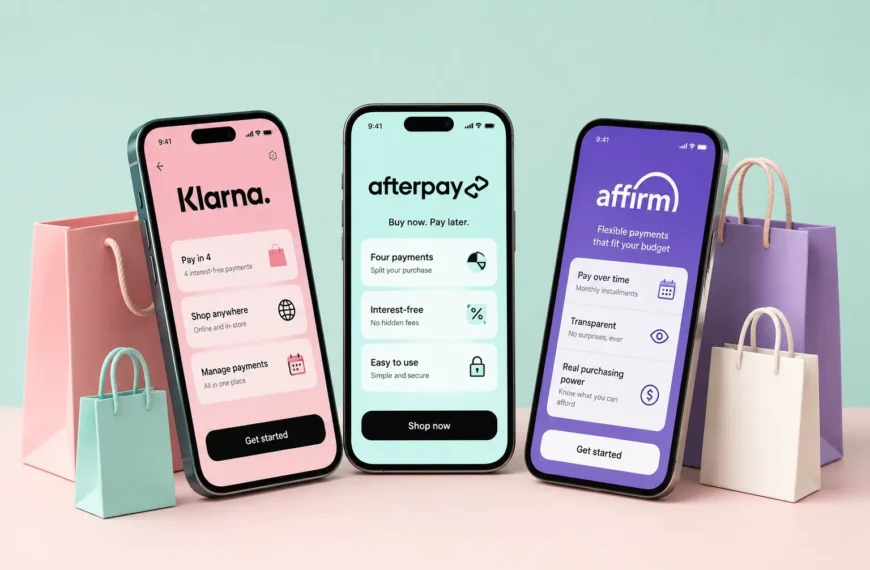
At a Glance: Side-by-Side Mobile Comparison
Afterpay Pros & Cons
Pros:
- Instant approval with minimal credit friction
- Clean Pay-in-4 model with capped, predictable late fees
- Now usable almost anywhere Visa is accepted via Cash App Afterpay on the Cash App Card
Cons:
- Standard Afterpay checkout is still limited to partnered merchants unless you’re using it through Cash App
- Missing multiple payments will restrict your account and shrink your spending limit
- No long-term financing option for big-ticket purchases
Klarna Pros & Cons
Pros:
- One-Time Virtual Visa Card usable at almost any online store
- Long-term financing (up to 36 months) available for larger purchases
- Cashback rewards program on purchases made through the Klarna app
Cons:
- Financing options carry real APR, up to roughly 20–34% depending on your credit
- Unpaid balances can end up with a third-party debt collector
- Klarna Plus subscription ($7.99/month) only pays off for frequent shoppers
Frequently Asked Questions About Klarna and Afterpay
Does Klarna or Afterpay build your credit score? Neither one builds your credit through standard Pay-in-4 use. Both run only a soft credit check and don’t report on-time Pay-in-4 payments to the major bureaus. Klarna’s longer financing plans (6–36 months) are the exception — those do report to TransUnion and Experian and can help build a credit history if paid on time.
Can I use Afterpay and Klarna at the same time? Yes. There’s no rule preventing you from having active accounts and balances on both apps simultaneously. Just be aware that neither service checks what you owe on the other, so it’s easy to overcommit your budget across both.
Which app gives you a higher starting limit? It depends entirely on your individual approval, which both apps calculate using proprietary algorithms based on your purchase history, linked bank activity, and repayment behavior rather than a published starting limit. New users on both platforms typically start with modest limits — often under $1,000 — that grow with a track record of on-time payments.
What happens if I have a dispute over a BNPL purchase? Since the CFPB withdrew its 2024 BNPL interpretive rule and hasn’t reissued a replacement, dispute rights aren’t standardized by federal regulation the way they are for credit cards. Your options depend on the individual provider’s policies — check Klarna’s or Afterpay’s help center for their current dispute process — and, if you’re using a card-based product like Cash App Afterpay, the Visa network’s standard dispute process may also apply.
 By
By