

Is IUL a Good Investment in 2026? The Fiduciary Truth
Table of Contents
- What Is an IUL Policy?
- How Does an IUL Work?
- The 2026 Tax Landscape: IUL as a LIRP
- The Hidden Costs: Why Most Advisors Hate IULs
- IUL vs. Buy Term and Invest the Rest (BTID)
- Is IUL Better Than a Roth IRA or 401(k)?
- FAQs About IUL Policies
- Conclusion: Who Should Actually Buy an IUL?
What Is an IUL Policy? {#what-is-iul}
Indexed Universal Life (IUL) is not a pure investment. It is a permanent life insurance policy with a cash value component linked to a stock market index — usually the S&P 500. You get a death benefit for your heirs and a savings bucket that can grow tax-advantaged. But that growth comes with strict limits, rising internal costs, and layers of fees most agents never mention upfront.
For the vast majority of Americans, there are better tools available. For a small group of high-income earners who have already maxed out every other tax shelter, the IUL can make strategic sense. This article will show you exactly which group you belong to — and why that answer matters enormously.
How Does an Indexed Universal Life (IUL) Policy Work?{#how-iul-works}
The “Zero Is Your Hero” Pitch: Floors and Caps Explained
Every IUL agent leads with the same line: “You can never lose money.” That’s technically true — but only half the story.
Here is how it actually works:
- Floor rate: Usually 0%. If the S&P 500 drops 30% in a crash year, your cash value stays flat. You don’t lose money. ✅
- Cap rate: Usually 8%–10%. If the S&P 500 gains 25% in a great year, you’re capped at the ceiling. You miss most of the upside. ❌
Over a long period — 20 or 30 years — missing the big market years devastates your compounding. The S&P 500 has returned roughly 10.5% annually on average since 1957 (source: Macrotrends S&P 500 historical data). An IUL with an 8% cap cuts that advantage significantly, especially once fees are factored in.
Understanding Participation Rates and Spread Rates
Two other numbers your agent might gloss over:
Participation Rate — If the index gains 10% and your participation rate is 80%, you receive 8%. The insurance company keeps the rest.
Spread Rate — Some policies subtract a fixed percentage before crediting you. If the index gains 8% and the spread is 2%, you receive 6%.
These two mechanics, combined with the cap, can turn a seemingly good market year into a mediocre return inside your policy.
The 2026 Tax Landscape: Why High-Earners Use IULs as a “LIRP” {#tax-landscape}
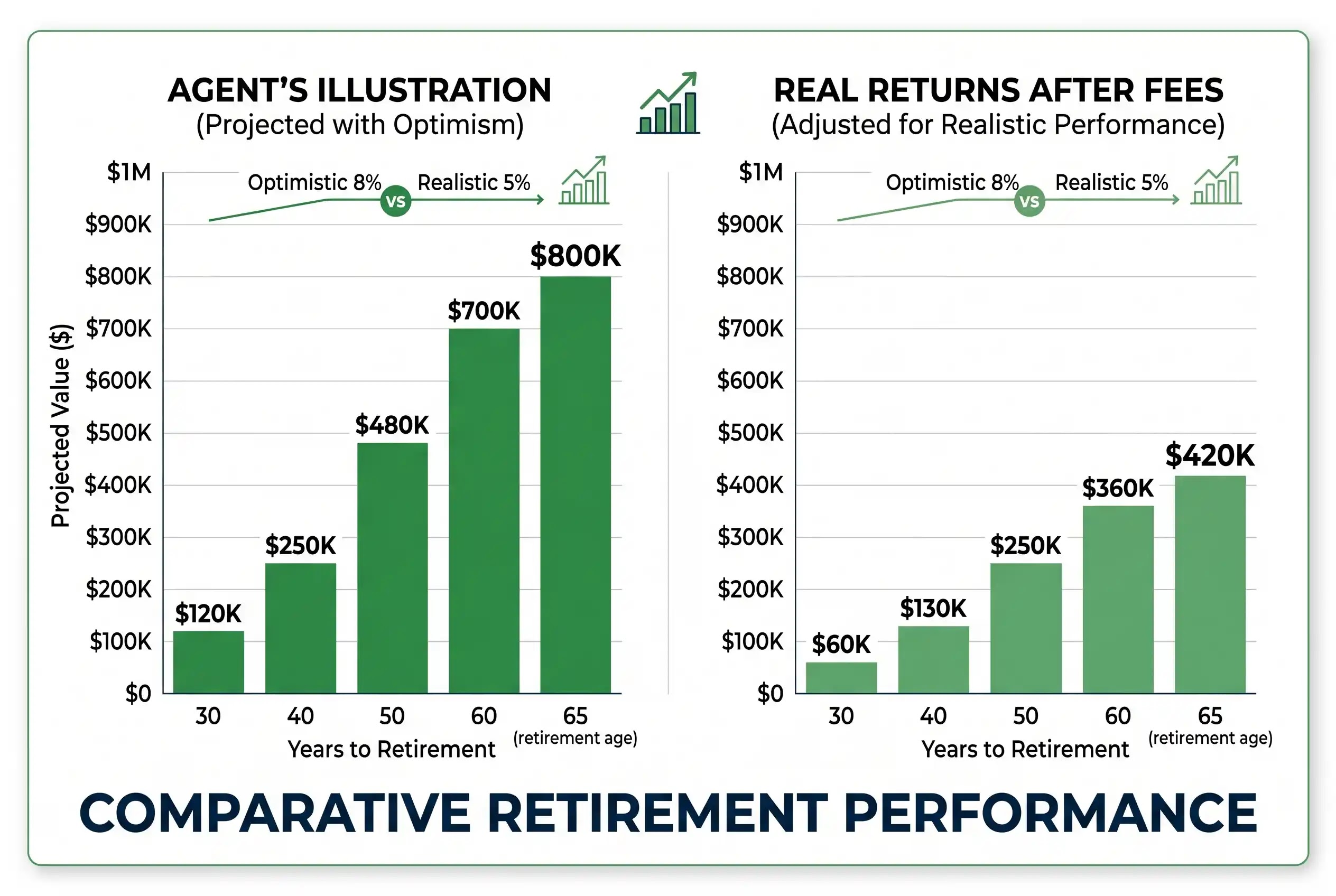 |
| Higher tax brackets in 2026 make tax-free growth more valuable than ever. |
TCJA Expiration: Navigating Higher Income Tax Brackets
The Tax Cuts and Jobs Act (TCJA) — the major 2017 tax reform law — reduced income tax rates for most Americans. Many of those cuts expired at the end of 2025. In 2026, top marginal rates climbed back toward 39.6% for the highest earners.
That shift matters. When tax rates are high, tax-free growth becomes more valuable. This is the main reason wealthy individuals and their estate attorneys have been looking at IULs more seriously in 2026.
Tax-Free Loans: How to Pull Retirement Income Without Triggering Capital Gains
One of the IUL’s genuine advantages is the policy loan strategy. Here’s how it works:
- You build up cash value inside the policy over many years.
- In retirement, instead of withdrawing money (which could be taxable), you borrow against your own cash value.
- Loans from a life insurance policy are not considered taxable income under current IRS rules.
When you die, the death benefit pays off the loan, and your heirs receive the remainder tax-free.
This is what financial planners call a LIRP — a Life Insurance Retirement Plan. It’s a legitimate strategy — but it works best for people earning $250,000+ per year who have already maxed out every other retirement account.
The MEC Trap: Passing the IRS “7-Pay Test” When Overfunding
If you pour too much money into an IUL too quickly, the IRS reclassifies it as a MEC — a Modified Endowment Contract. Once it becomes a MEC, you lose all the tax-free loan advantages that make the strategy worthwhile. Withdrawals become taxable and subject to a 10% penalty before age 59½.
The 7-Pay Test is the IRS rule that defines the maximum amount you can contribute in the first seven years without triggering MEC status. A good agent will design your policy around this limit. But overfunding — strategically, just below the MEC threshold — is exactly what you want to do to maximize growth.
The Hidden Costs: Why Most Financial Advisors Hate IULs{#costs}
The Rising Cost of Insurance (COI) in Later Years
Inside every IUL policy, there is a real cost of life insurance. It’s called the COI — Cost of Insurance. This charge is deducted from your cash value every month, and it increases every year as you get older.
Here’s the danger: if your policy is underfunded — meaning you didn’t put in enough money in the early years — the rising COI can eat through your cash value in your 60s and 70s. In worst-case scenarios, the policy lapses (collapses), leaving you with no death benefit and a surprise taxable event on all the gains you borrowed against.
This is not a scare tactic. It’s math. Any fee-only financial planner can run this illustration for you.
Surrender Charges and Front-Loaded Commissions
In the first 10 to 15 years of an IUL policy, surrender charges apply if you want to cancel. These can be 10%–20% of your cash value in year one, declining gradually. Walk away early, and you lose a significant chunk of what you put in.
On the other side of that transaction: your agent typically earns a commission of 80%–120% of your first-year premium. On a policy where you pay $1,000/month, that’s up to $12,000 in commissions — paid in year one, mostly from your money.
This is not illegal. But it does explain why IUL is aggressively sold, and why the distinction between a fiduciary advisor (legally required to act in your best interest) and a broker (legally allowed to recommend products that are merely “suitable”) matters so much.
For more on fiduciary vs. broker differences, see FINRA’s investor guide
AG 49-B: Why You Can Never Trust a Broker’s “Illustration”
AG 49-B (Actuarial Guideline 49-B) is a regulation introduced by the National Association of Insurance Commissioners (NAIC) specifically to rein in misleading IUL sales illustrations.
Before AG 49-B, agents could show you projections assuming 8%, 9%, or even 10% annual returns — numbers that looked great on paper but were based on cherry-picked historical data and optimistic assumptions.
AG 49-B tightened those rules. But agents can still present illustrations that look rosier than reality, especially by using exotic crediting strategies called multipliers or bonuses that carry their own hidden costs.
Rule of thumb: Never trust any IUL illustration without having it reviewed by a fee-only financial advisor who earns zero commission from insurance sales.
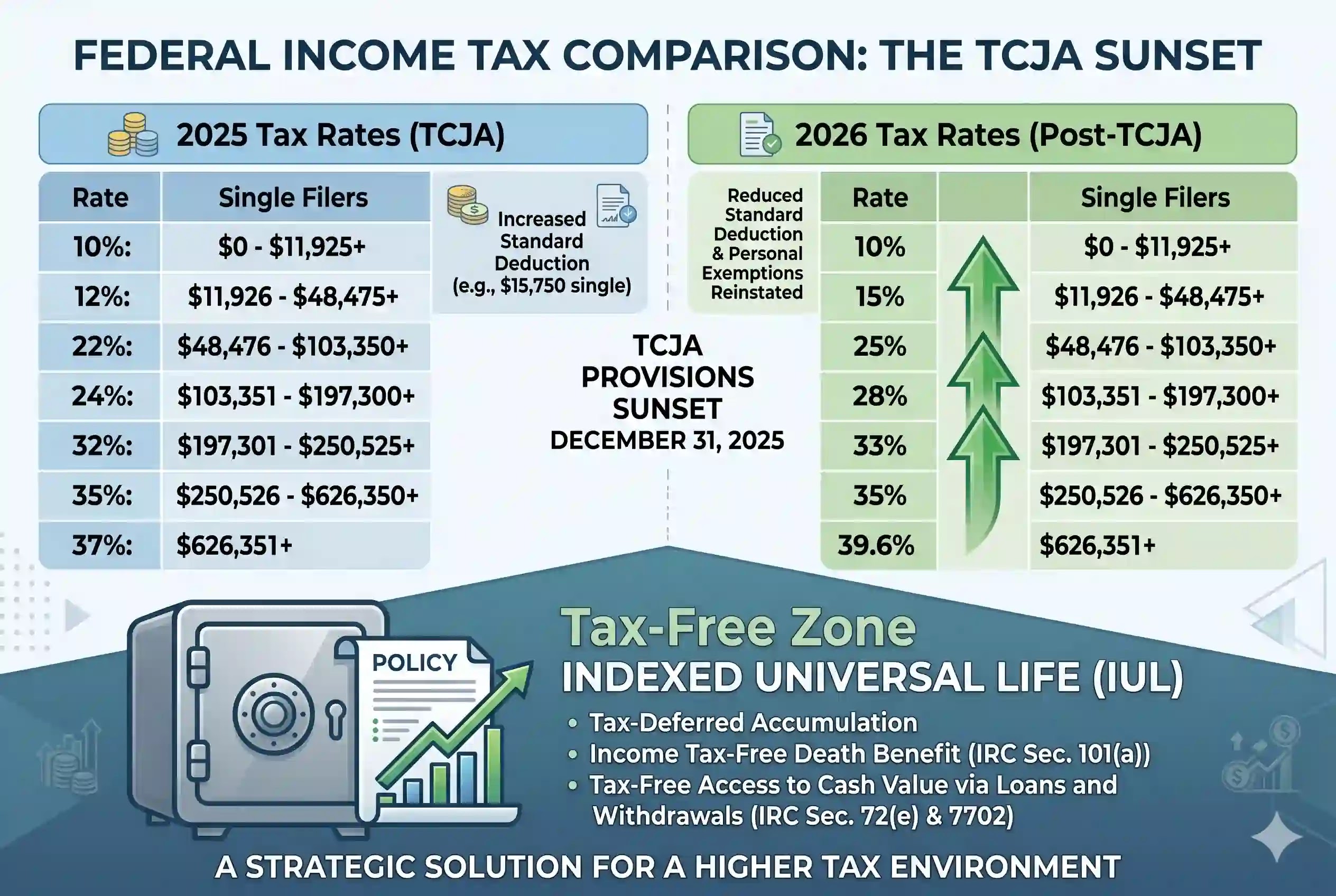 |
| What the illustration shows vs. what you actually get can be dramatically different. |
The Ultimate Showdown: IUL vs. “Buy Term and Invest the Rest” (BTID)
This is the debate that divides financial planners.
The Setup: A 35-year-old male, non-smoker, in good health, allocates $1,000/month for 30 years.
Option A: IUL Policy
- Premium: $1,000/month
- Internal fees, COI, and admin charges: ~$150–$200/month in early years, rising with age
- Assumed net return after caps and fees: ~4%–6%/year
- Estimated cash value at age 65: $400,000–$550,000 (varies widely by policy design)
- Death benefit: ~$500,000+
- Tax treatment: Tax-advantaged loans available
Option B: Buy Term + Invest the Difference (BTID)
- 30-year term life insurance (same death benefit): ~$50–$80/month
- Remaining $920–$950 invested in an S&P 500 index fund
- Assumed gross return: ~10%/year (historical average)
- Estimated portfolio at age 65: $1,800,000–$2,100,000
- Tax treatment: Capital gains taxes apply on withdrawals; Roth conversion possible
The verdict: In most scenarios, BTID produces dramatically more wealth. The IUL wins only in specific situations — particularly when you’ve maxed out all tax-advantaged accounts and face very high income taxes in retirement.
Note: These are estimates for illustration purposes. Actual results depend on your health, specific policy, market performance, and tax situation. Always consult a fee-only financial advisor.
Is IUL Better Than a Roth IRA or 401(k)?
No — and the order matters.
Think of retirement vehicles in tiers:
Level 1 — Always do this first:
- 401(k) or 403(b) up to your employer’s full match. This is an instant 50%–100% return. Never leave it on the table.
Level 2 — Do this next:
- Max out your Roth IRA ($7,000/year in 2026; $8,000 if you’re 50+). Tax-free growth, no required minimum distributions, flexible withdrawals.
- Max out your 401(k) beyond the employer match ($23,500 limit in 2026).
- If self-employed: max out a SEP-IRA or Solo 401(k).
Level 3 — Consider this only after Level 1 and Level 2 are fully funded:
- Indexed Universal Life (IUL)
- Whole Life Insurance
- Annuities
The IUL is a Level 3 asset. It is not a replacement for foundational retirement accounts — it is a supplement for people who have already saturated every better option.
IRS contribution limits for 2026: IRS Retirement Plan Contribution Limits
FAQs About IUL Policies {#faqs}
Can you lose money in an IUL?
Your cash value cannot go below zero in a standard IUL — the 0% floor protects you in down market years. However, you can effectively lose money through fees, surrender charges if you cancel early, or if the policy lapses due to underfunding. In a lapse scenario, you may also owe income taxes on gains you borrowed against.
What is the realistic average return of an IUL?
Ignore the agent’s illustration. The realistic net return — after all fees, COI charges, and the impact of caps and participation rates — is typically 4% to 6% per year for a well-funded policy. Some policies perform below 3%. This is significantly lower than the historical S&P 500 return of ~10.5%.
How much commission does an agent make on an IUL?
Commissions are not standardized, but industry data suggests agents typically earn 80%–120% of the first-year premium on a new IUL policy, plus smaller trailing commissions in subsequent years. On a $1,000/month policy, that’s roughly $9,600–$14,400 in year one alone. This incentive structure is why IUL is sold so aggressively — and why you should always seek a second opinion from a fee-only advisor before buying.
Conclusion: Who Should Actually Buy an IUL? {#conclusion}
The IUL is a powerful — and genuinely useful — financial tool. For the right person.
The IUL makes sense if you:
- Earn $250,000+ per year
- Have already maxed out your 401(k), Roth IRA, and all other tax-advantaged accounts
- Have a long-term estate planning need (leaving wealth to heirs tax-efficiently)
- Are working with a fee-only fiduciary planner — not a commissioned agent
- Can commit to overfunding the policy for at least 10–15 years
The IUL is a poor fit if you:
- Are still building your emergency fund
- Haven’t maxed out your 401(k) employer match
- Need flexibility and may need to access funds within 10 years
- Are a middle-income earner looking for a retirement savings vehicle
- Bought one based on a TikTok video or an agent’s glossy illustration
The bottom line: IUL is an excellent tool for ultra-high-net-worth individuals navigating estate taxes and the post-TCJA tax environment. It is a poor substitute for a Roth IRA for most Americans. Know which group you’re in before writing a check.
Want personalized advice? Find a fee-only fiduciary financial advisor through NAPFA.org— the National Association of Personal Financial Advisors. These advisors charge flat fees and earn zero commission from insurance sales.
Disclaimer: This article is for educational purposes only and does not constitute financial, tax, or legal advice. Consult a qualified financial professional before making any investment or insurance decisions.

 By
By