
 |
| Land investing in 2026 goes beyond holding — solar leasing and carbon credits create real cash flow. |
Is Land a Good Investment? The 2026 Strategic Guide
Table of Contents
- The New ROI: Is Land a Good Investment in 2026?
- How to Generate Passive Income from Vacant Land
- The Hidden Costs and Risks of Owning Land
- The Technical Due Diligence Checklist for Buying Land
- Tax Advantages of Investing in Land
- Land vs. Dividend Stocks vs. Rental Properties
- FAQs Before Buying Your First Plot of Land
- Conclusion: Should You Add Land to Your Portfolio?
Yes, land is still a great investment in 2026 — but the rules have changed. It’s no longer just a passive store of value. Today, raw land is an active platform for generating income through solar leasing, carbon credits, and strategic development. Knowing which play fits your goals is what separates smart investors from those just holding dirt.
The New ROI: Is Land a Good Investment in 2026?{#roi}
Land has always been the ultimate inflation hedge. When the dollar loses purchasing power, land holds — or grows — its value. But the old pitch of “they’re not making more land” barely scratches the surface of the opportunity in 2026.
Today’s land investors earn returns through multiple income streams that didn’t exist a decade ago. Solar leasing, carbon credit programs, conservation easements, and short-term rental hospitality have turned vacant land into a productive asset class — one that competes seriously with REITs (Real Estate Investment Trusts) and dividend portfolios.
The core thesis is simple: land protects your capital against inflation while unlocking new monetization layers. The question is no longer “should I buy land?” but “which type, and what’s my exit or income strategy?”
Raw Land vs. Infill Lots: Choosing Your Asset Class
Not all land is equal. Understanding the difference will save you from buying the wrong asset.
Raw land refers to completely undeveloped parcels — no utilities, no roads, no improvements. It’s the cheapest to buy and the highest risk-to-reward play. Raw land suits investors with patience and a long time horizon, especially those targeting solar or agricultural lease income.
Infill lots are vacant parcels located inside developed areas — think an empty lot between two houses in a suburb. They already have road access and utilities nearby. These are builder-ready and move faster on the market. Infill lots are ideal if your strategy is to develop, flip, or sell to a builder.
Your choice should match your capital, timeline, and income goals. Raw land = long game. Infill lots = faster cycle.
The “Land Banking” Strategy Explained
Land banking means buying raw land today in the path of future development, then holding it until the market catches up. It’s a patient strategy, but the returns can be extraordinary.
Investors who bought land on the outskirts of cities like Austin, Phoenix, and Nashville in 2010–2015 saw appreciation of 300–600% by the early 2020s. In 2026, the best opportunities are in secondary metros where remote work migration is still driving housing demand: think Boise, Chattanooga, and Greenville, SC.
The key is buying ahead of infrastructure — highways, data centers, and hospitals. These anchors pull residential and commercial development with them.
How to Generate Passive Income from Vacant Land{#passive-income}
Vacant land doesn’t have to sit idle. Here are the three most powerful income strategies in 2026.
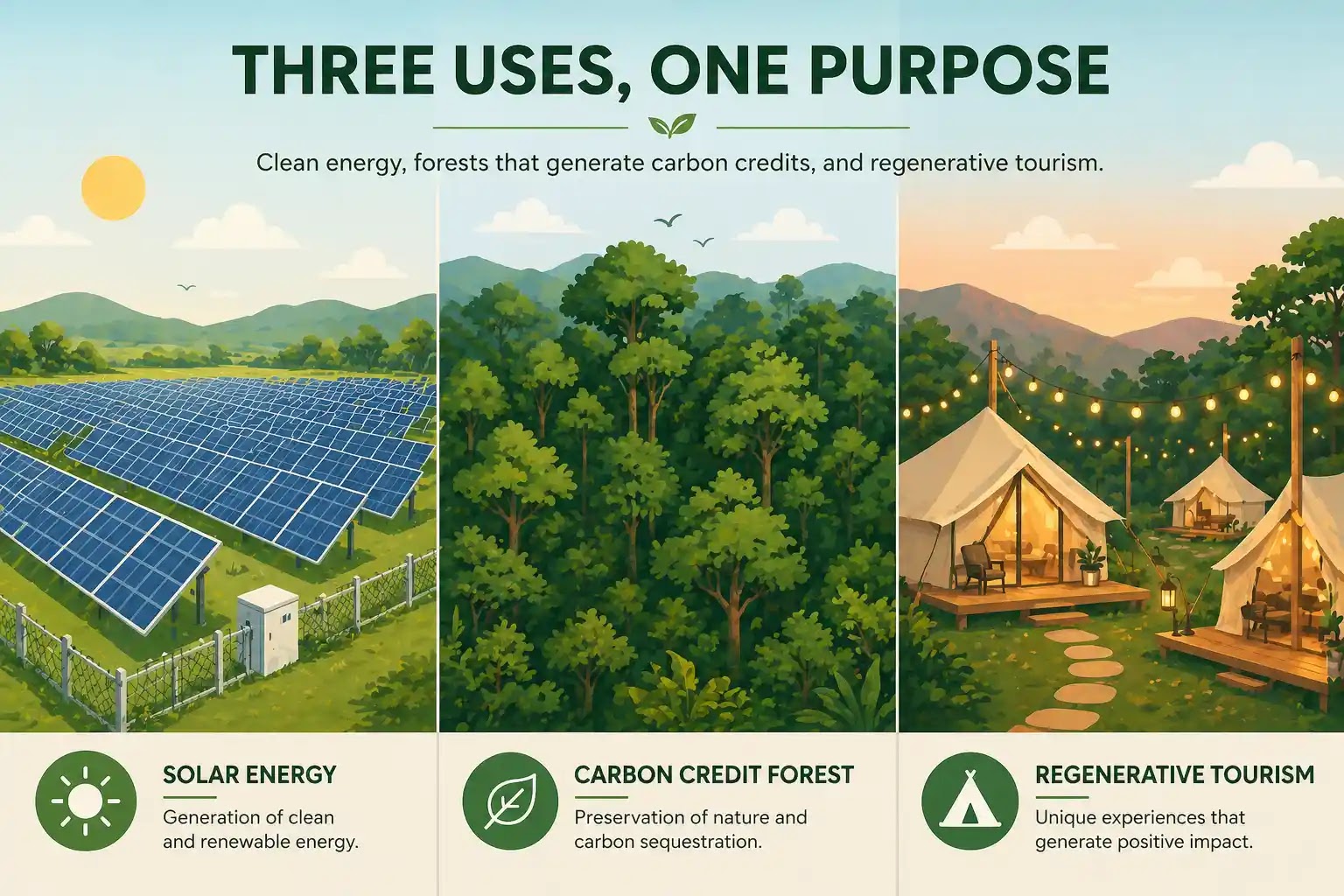 |
| Solar leasing, carbon farming, and glamping are the top three ways to monetize vacant land without building. |
Solar Land Leasing: Turning Sun into Cash Flow
Solar developers are hungry for land. They need flat, sunny, road-accessible parcels — and they’ll pay you to use them for 20–30 years.
A typical solar land lease pays between $500 and $2,000 per acre per year, depending on location, sun exposure, and grid proximity. A 50-acre parcel could generate $50,000–$100,000 annually — completely passive.
The lease is structured as a long-term agreement. You keep ownership. You collect rent. At the end of the term, the developer removes equipment and you get the land back.
To explore current rates and lease terms, the American Clean Power Association (cleanpower.org) publishes developer directories by region.
Carbon Farming and Conservation Easements (2026 Tax Updates)
Carbon markets have matured significantly. In 2026, landowners with forests, wetlands, or grasslands can earn carbon credits by committing to conservation practices. Each credit represents one metric ton of CO₂ sequestered or avoided.
Credits sell on voluntary markets for anywhere from $10 to $50+ per ton, depending on project quality and buyer. A well-managed 100-acre woodland could generate 200–500 credits per year.
Conservation easements are a related tool. You voluntarily restrict development on your land in exchange for a tax deduction equal to the value of the rights you give up. Under 2026 rules, qualified conservation contributions remain deductible — consult a tax advisor familiar with IRS Section 170(h) for current limits.
External resource suggestion: carbon credit programs for landowners you should take a look at: terrapass.com or americanforest.org
Short-Term Rentals: Glamping and RV Hosting
You don’t need a structure to generate rental income from land. The outdoor hospitality industry is booming.
- Glamping (glamorous camping): Set up pre-fabricated tent cabins, geodesic domes, or Airstream trailers. List on platforms like Hipcamp or Glamping Hub.
- RV hosting: Allow RV travelers to park and hook up utilities on your land. Simple, low-maintenance, and growing fast.
- Hunting leases: If your land has wildlife, hunters pay annual fees for seasonal access — typically $5–$20 per acre per year.
The Hidden Costs and Risks of Owning Land{#risks}
No investment guide is complete without the full picture. Land has real risks — and ignoring them is how investors get burned.
The Illiquidity Factor: Why Patience is Required
Land does not move fast. When you need to sell, you may wait 6–24 months for the right buyer. Unlike dividend stocks, you can’t liquidate a land position in an afternoon.
This illiquidity is the primary reason land should represent no more than 20–30% of a diversified portfolio for most investors. If you may need the capital within 3 years, land is the wrong asset.
Holding Costs: Property Taxes and Liability Insurance
Even when land sits idle, costs accumulate. Property taxes on vacant land vary widely — from $50/year on rural parcels to $5,000+/year on suburban lots in high-tax states.
Liability insurance is often overlooked. If someone trespasses and gets injured on your land, you can be held responsible in many states. Basic vacant land liability policies run $200–$600 per year and are non-negotiable.
Always calculate your annual holding cost (taxes + insurance + any maintenance) and compare it to your expected appreciation or income.
The Danger of Eminent Domain and HOA Restrictions
Eminent domain is the government’s power to take private property for public use, with compensation. It’s rare — but it happens, especially on land near planned roads, pipelines, or utility projects. Always check local government development plans before buying.
HOA (Homeowners Association) restrictions and deed covenants can severely limit what you do with land — even in rural areas. Always request and read the full title commitment and any recorded restrictions before closing.
The Technical Due Diligence Checklist for Buying Land{#due-diligence}
This is where most buyers make expensive mistakes. Skipping technical due diligence has killed more land deals — and investor returns — than any market downturn.
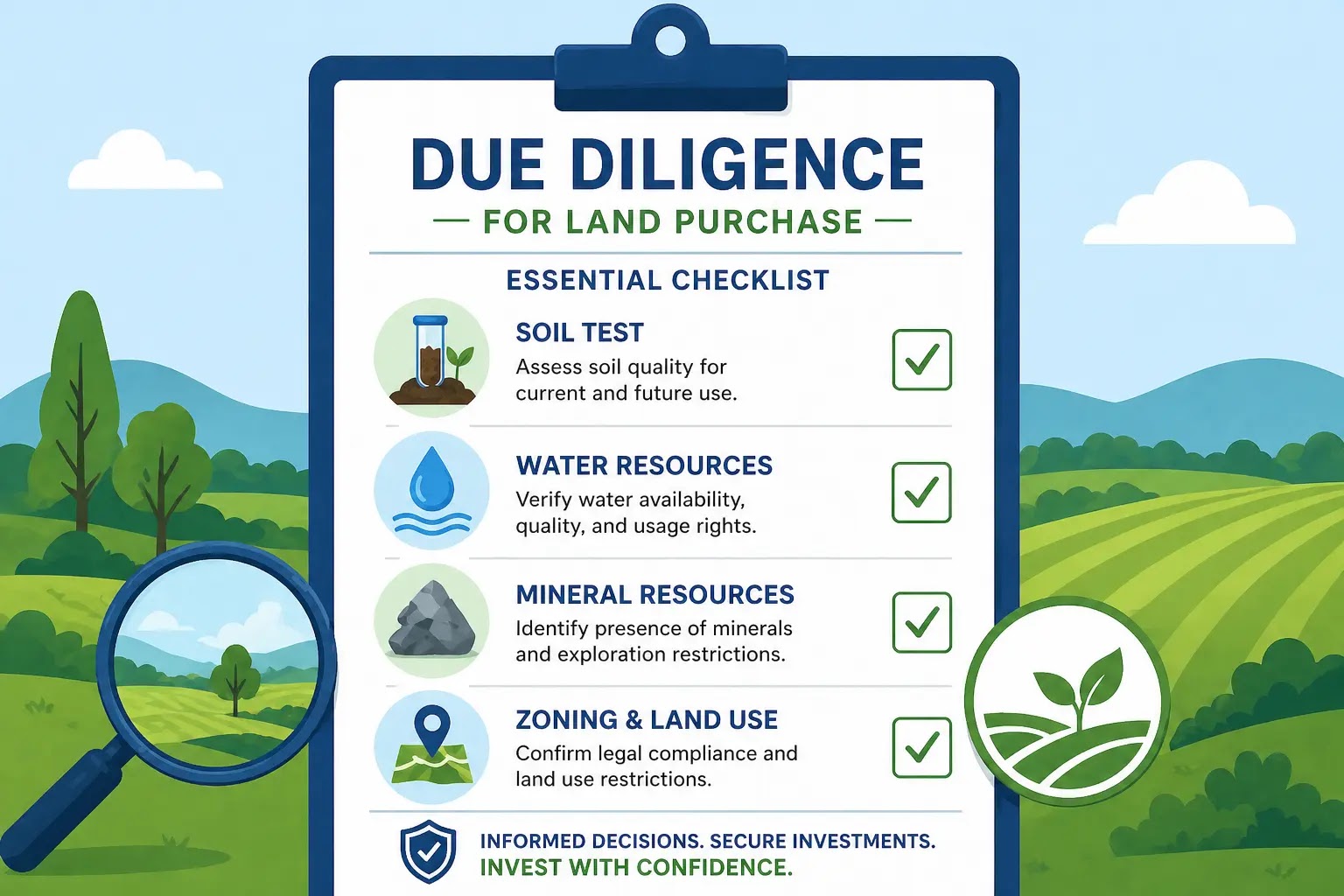 |
| Always verify perc test results, water rights, mineral rights, and zoning before closing on any land deal. |
Why You Must Demand a Perc Test (Percolation Test)
If the land has no connection to a municipal sewer system — which is most raw land — it will need a septic system for any future development. A perc test (percolation test) measures how well the soil absorbs water. It determines whether a septic system is feasible.
Failing a perc test means the land may be unbuildable for residential use. This is a massive red flag that most buyers discover too late. Always require a current perc test result as a condition of your offer.
The Crucial Difference Between Surface Rights, Water Rights, and Mineral Rights
Owning land does not automatically mean you own everything on, above, or below it. Rights are often severed — meaning different parties may own different layers.
- Surface rights: The right to use the surface of the land.
- Water rights: In many western states, water rights are separate from land ownership and are governed by the doctrine of prior appropriation. You may own land with a river running through it and have no legal right to the water.
- Mineral rights: The right to extract oil, gas, coal, or other minerals. If a previous owner sold the mineral rights, a mining company could legally access your property.
Always order a title search that specifically identifies which rights are included in your purchase. If mineral rights are severed, require title insurance that covers mineral extraction liability.
Understanding Zoning Designations and Entitlements
Zoning tells you what the land can legally be used for. Common designations include:
- A-1 / AG: Agricultural
- R-1 through R-3: Residential (single family to multi-family)
- C-1 / C-2: Commercial
- I-1 / I-2: Industrial
Entitlements are approved permits and zoning changes that allow a specific use. Entitled land — where a builder already has approval for a subdivision, for example — commands a significant premium because the risky approval process is complete.
Buying land and successfully getting it entitled (rezoned) for higher-density use is one of the highest-return strategies in real estate — but it carries regulatory risk and requires patience.
Tax Advantages of Investing in Land{#tax}
Land investing comes with a meaningful tax toolkit that most investors don’t fully use.
How to Use a 1031 Exchange to Defer Capital Gains Taxes
A 1031 exchange (named after IRS Section 1031) allows you to sell an investment property and reinvest the proceeds into a like-kind property — without paying capital gains taxes immediately. The gain is deferred, not forgiven.
For land investors, this is powerful. Sell appreciated land, roll the proceeds into another parcel (or into improved real estate), and your tax bill is pushed into the future — potentially forever if you continue exchanging.
Key rules:
- You must identify the replacement property within 45 days of the sale.
- You must close on the replacement within 180 days.
- Both properties must be held for investment or business use — not personal use.
External suggestion: IRS1031 exchange rules guidelines to irs.gov
Claiming Tax Deductions via Conservation Easements
As noted earlier, donating a conservation easement can generate a significant federal income tax deduction. The deduction equals the fair market value of the development rights you permanently restrict.
For example: land appraised at $500,000 for development, but only $200,000 as conserved land, yields a $300,000 deduction. At a 37% marginal tax rate, that’s $111,000 in federal tax savings.
The IRS has tightened rules on syndicated conservation easements — where promoters sell partnership interests specifically to generate inflated deductions. Work exclusively with qualified attorneys and appraisers, and avoid any deal marketed primarily as a tax shelter.
Land vs. Dividend Stocks vs. Rental Properties{#comparision}
How does land stack up against other popular income investments? Here’s a plain-text breakdown across four key metrics:
Liquidity
- Land: Low. Selling takes months. Not suitable for short-term capital needs.
- Dividend Stocks: High. Sell in seconds during market hours.
- Rental Properties: Low-to-Medium. Faster than land but still weeks to months.
Passive Cash Flow
- Land: Low initially, but high with solar, carbon, or glamping leases in place.
- Dividend Stocks: Medium-to-High. Reliable quarterly or monthly distributions.
- Rental Properties: Medium-to-High. Monthly rent, minus expenses and vacancies.
Maintenance Requirements
- Land: Very Low. No toilets to fix, no tenants to manage (unless actively hosting).
- Dividend Stocks: None. Fully managed by the company.
- Rental Properties: High. Repairs, tenant management, and vacancies are constant.
Inflation Protection
- Land: Excellent. Hard asset with intrinsic scarcity.
- Dividend Stocks: Variable. Depends on the company’s ability to raise prices.
- Rental Properties: Good. Rents tend to rise with inflation over time.
Bottom line: Land fills a specific portfolio role — inflation hedge, capital preservation, and long-term appreciation — that stocks cannot replicate. It’s not a replacement for equities; it’s a complement.
FAQs Before Buying Your First Plot of Land{#faqs}
Do banks finance raw land purchases?
Yes, but financing is harder than for improved properties. Most conventional lenders won’t touch raw land. Your options are:
- Local community banks and credit unions: More flexible on rural land.
- USDA Farm Service Agency (FSA) loans: For agricultural land.
- Seller financing: Often the best deal — the seller acts as the bank. Negotiate directly.
- Land-specific lenders: Companies like Mossy Oak Properties and AcreTrader sometimes offer financing.
Expect to put down 20–50% and pay higher interest rates than a standard mortgage.
How much should I pay in property taxes for vacant land?
Property taxes on vacant land vary enormously by state and county. In general:
- Rural land in low-tax states (Texas, Tennessee, Georgia): $1–$5 per acre per year.
- Suburban infill lots: $500–$5,000+ per year, depending on assessed value.
- Agricultural-use exemptions (called “Ag exemptions” in many states): Can reduce taxes by 50–90% if the land qualifies for farming, ranching, or timber use.
Always verify the current assessed value and tax rate with the county assessor before making an offer. Ask whether an agricultural exemption is in place and whether it transfers to a new owner.
Conclusion: Should You Add Land to Your Portfolio?{#conclusion}
Land in 2026 is not the sleepy, “set it and forget it” asset it once was. It’s a multi-dimensional investment that can hedge inflation, generate passive income through solar and carbon lease programs, and build generational wealth through strategic appreciation.
The right land investment requires clear strategy: know your asset class (raw vs. infill), nail the due diligence (perc test, rights, zoning), and have a defined income or exit plan before you sign a deed.
Is land a good investment? For patient investors with clear goals and proper research — absolutely yes.
Ready to explore land opportunities? Start by researching AcreTrader, LandWatch, and Lands of America for current listings in your target markets. Then consult a real estate attorney and a tax advisor before making your first move.
Disclaimer: This article is for informational purposes only and does not constitute financial or legal advice. Always consult a qualified professional before making investment decisions.

 By
By