

If you’ve ever asked yourself which money transfer app is the best, you’re not alone — and the answer has changed dramatically in 2026. New laws, artificial intelligence, and a major regulatory shift have reshuffled the rankings. The right app depends entirely on what you’re moving, where it’s going, and who you are as a user.
This guide breaks it all down: fees, speed, hidden FX (foreign exchange) markups, new IRS tax rules, and even how to move money between apps that weren’t designed to talk to each other. By the end, you’ll know exactly which app wins for your situation.
The 2026 Landscape: How AI and New Regulations Have Transformed Digital Payments
Three forces are rewriting the rules for digital money movement right now.
First, AI has become an active participant — not just a helper. Apps like Venmo (now integrated with PayPal’s Agent Toolkit) allow AI assistants to execute transactions on your behalf using natural language commands. You say “split the dinner bill with Maria” and the agent does it. This is called agentic commerce, and it’s no longer a future concept. It’s live.
Second, NFC technology was democratized. Near Field Communication (NFC) — the chip inside your phone that powers tap-to-pay — was previously Apple’s exclusive territory on iOS. In 2025, Apple opened that capability to third-party developers. The result: apps like Cash App and PayPal can now function as point-of-sale payment instruments directly from your iPhone, without Apple Pay as an intermediary. This permanently altered the competitive landscape for mobile wallets.
Third, regulators caught up. The One Big Beautiful Bill Act (OBBBA), signed into law on July 4, 2025, introduced sweeping changes to how payment apps report your income to the IRS. More on that in the tax section — but know that millions of casual Venmo and Cash App users who feared IRS 1099-K forms for small transactions just got major relief.
Understanding these shifts is essential before you pick an app. The platform that was “best” in 2023 may not even rank in the top three for your needs today.
Top Money Transfer Applications Categorized by Specialized Utility
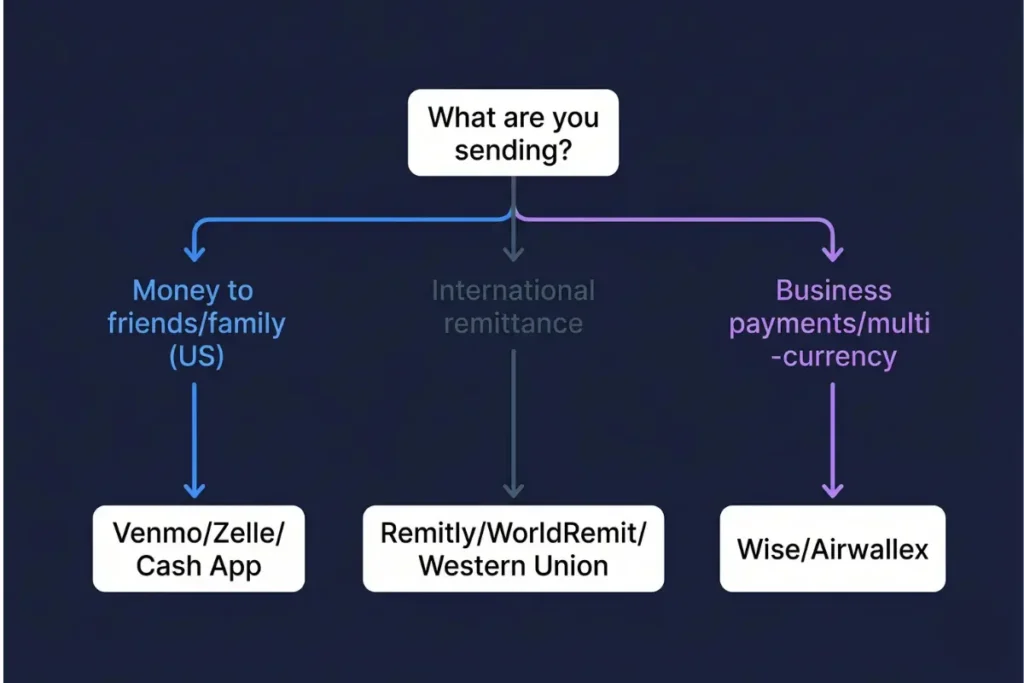
There is no single “best” money transfer app for everyone. The right choice depends on your use case. Here’s how to find yours.
Best for Instant Domestic P2P & Social Expense Management: Venmo, Zelle, Cash App
These three apps dominate American peer-to-peer (P2P) transfers — everyday payments between friends, family, and people you trust.
Venmo is the social layer of digital payments. Splitting dinner, paying your roommate, or sending birthday money all happen in a feed that looks like social media. Standard bank-linked transfers are free and arrive in 1–3 business days via ACH (Automated Clearing House). Instant transfers cost 1.5% (minimum $0.25, maximum $15). Credit card payments carry a 3% fee.
What makes Venmo uniquely powerful in 2026 is the PayPal Agent Toolkit integration. Venmo’s parent company has built NLP (natural language processing) routing directly into its API (Application Programming Interface). The practical implication: third-party AI assistants can now initiate Venmo payments on your behalf through conversational commands. Think of it as giving your calendar AI permission to handle the office lunch split automatically.
Zelle works differently. It connects directly between U.S. bank accounts — no app balance, no digital wallet. Money moves in minutes, bank-to-bank. It’s built into most major banking apps (Chase, Bank of America, Wells Fargo, and more), so there’s nothing extra to install. The catch: Zelle offers zero purchase protection and almost no dispute resolution. If you send money to the wrong person, recovering it is extremely difficult.
Cash App plays in a completely different league for users who want more than just transfers. It offers:
- Fractional stock trading — buy $1 of Apple or Tesla, no brokerage account required
- Bitcoin accumulation — round-up purchases to stack sats (small amounts of Bitcoin)
- Cash App Card — a free Visa debit card linked to your balance
- AI-powered assistant — conversational commerce embedded directly in the app
For a server, a barber, or a freelancer receiving tips via Cash App, the 2026 tax environment (covered below) creates a uniquely favorable scenario.
Which one wins? Zelle for speed and simplicity. Venmo for social coordination. Cash App for users building long-term financial habits alongside their transfers.
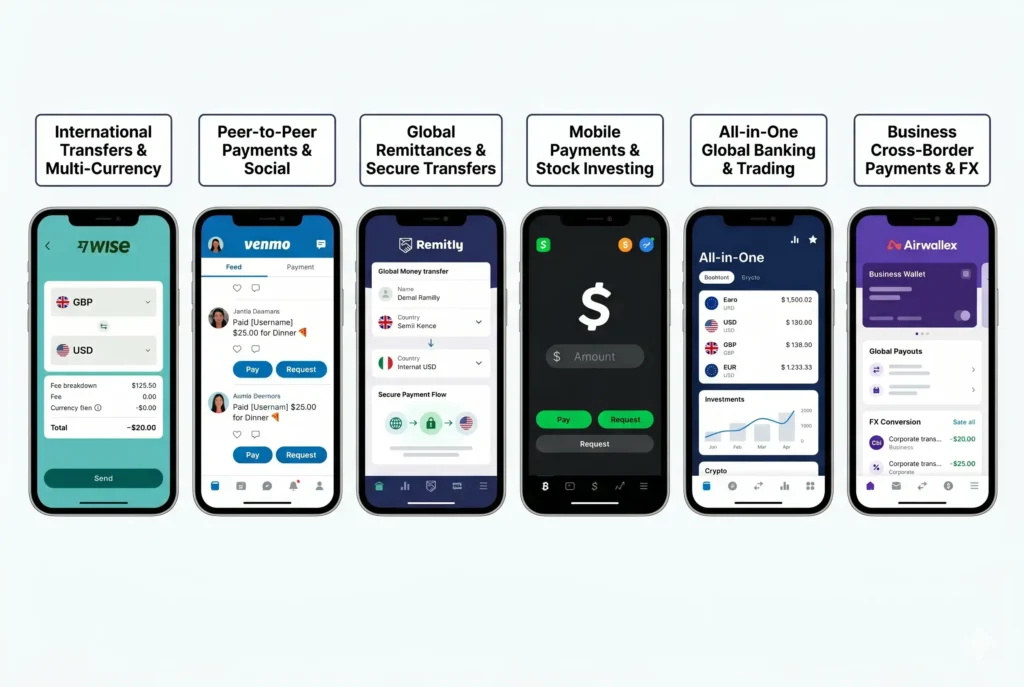
Best for International Remittances & Family Support: Remitly, WorldRemit, Western Union
If you’re sending money abroad — to a parent in Mexico, a sibling in the Philippines, or a spouse in Nigeria — the landscape is more complex and the stakes are higher.
The single most important concept to understand here is the difference between the advertised fee and the true cost. Apps like Remitly and WorldRemit often advertise transfers for $1.99 or “fee-free.” What they don’t highlight is the FX (foreign exchange) margin markup — the spread between the real mid-market exchange rate and the rate they actually give you.
Example: If you’re sending $1,000 to Mexico and the real exchange rate is 17.5 pesos per dollar, an app with a 3% FX margin markup gives you 16.975 pesos per dollar. You lose about $30 — invisibly. That’s more than the flat fee you saw advertised.
Here’s how the major remittance apps break down on total cost (fee + FX markup):
| App | Flat Fee | FX Markup | Delivery Speed | Best For |
|---|---|---|---|---|
| Remitly | $1.99–$4.99 | ~1.5–3.5% (varies by corridor) | Minutes (Express) | Latin America, Philippines |
| WorldRemit | $0–$3.99 | ~1.5–3% | Hours–1 day | Africa, Asia |
| Western Union | $0–$9.99 | ~2–4% | Minutes–days | Global cash pickup network |
Western Union’s physical cash pickup network remains unmatched for recipients without bank accounts. In rural Kenya, Bolivia, or Vietnam, receiving cash at a local agent — not a bank — can be the only practical option. No app can replicate that last-mile infrastructure.
Delivery optionality matters. In markets like the Philippines, Bangladesh, and much of sub-Saharan Africa, mobile wallet top-ups (directly to a GCash or M-Pesa balance) are faster and more practical than bank deposits. WorldRemit and Remitly both support this. Western Union offers home delivery in select corridors.
Pro tip: Always compare the total you’d receive at the destination — not just the fee. Most apps show this clearly if you enter the amount and destination country before confirming.
Best for Multi-Currency Digital Nomads: Wise, Revolut, Pesa
For frequent international travelers, remote workers, or anyone managing money across multiple currencies, this category is where the best money transfer apps separate themselves from the pack.
Wise (formerly TransferWise) built its entire brand on one principle: use the true mid-market exchange rate — the same rate you see on Google — with no embedded FX markup. Its fees are transparent: typically 0.33%–2.85% of the transfer, depending on the currency corridor, with no margin added to the rate. For a $5,000 wire from USD to EUR, Wise often costs $15–$40 total. A traditional bank might cost $40–$80 in fees plus a 2–3% FX spread you’d never see itemized. Wise holds 50+ currency balances, issues a multi-currency debit card, and is fully licensed across the US, UK, EU, and APAC regulatory bodies.
Revolut reached a major milestone in 2025 with the acquisition of a full UK banking license. This is significant for U.S. users to understand: in the UK and EU, Revolut customer deposits are now insured under the Financial Services Compensation Scheme (FSCS) up to £85,000. This changes Revolut’s risk profile from “fintech app” to “licensed bank” — a meaningful security upgrade. Revolut offers mid-market FX rates on weekdays, fee-free currency exchange up to plan limits, and an aggressive set of premium features for subscribers.
Pesa is a specialized platform for African financial corridors that most mainstream comparisons miss entirely. It offers zero transfer fees and instant mobile-first transactions across multiple African countries, specifically targeting the M-Pesa ecosystem and similar mobile money networks. For users operating between East African and European financial systems, Pesa eliminates the friction that Wise and Revolut still struggle with in those corridors.
Which one wins? Wise for pure transparency and trust. Revolut for full-featured banking. Pesa for African-corridor specialists.
Best for Enterprise, eCommerce, and B2B Treasury Operations: Airwallex, OFX
For businesses — from a solo eCommerce seller to a mid-market company paying contractors globally — personal payment apps create expensive bottlenecks. Enterprise-grade platforms solve different problems.
Airwallex is built for companies that collect revenue in multiple currencies and pay suppliers, contractors, or employees worldwide. Key 2026 capabilities:
- Local payout rails — pay contractors in 150+ countries using domestic banking infrastructure (no SWIFT fees)
- Like-for-like settlement — collect in USD, pay in USD, no forced conversion
- Automated global 1099 tax reporting — critical for U.S. companies with international contractors
- LockFX — lock in an exchange rate for future transactions to neutralize currency volatility
- High-yield treasury sweep program — idle business cash earns yield while held in the Airwallex account (with Enhanced FDIC sweep coverage up to $6M through partner banks)
Airwallex’s FX markup runs 0.5%–1.0% on conversions, with $0 fees on local rail routing. For a $500K annual payment volume, that difference vs. a traditional bank can represent $5,000–$15,000 in annual savings.
OFX focuses on forward contracts and larger business wire transfers, with human dealers available for high-value transactions. It’s particularly strong for import/export businesses managing predictable currency exposure months in advance.
Comparative Analysis Matrix: The 2026 Market Leaders
Use this table to find your match in under 60 seconds.
| Application | Primary Use Case | Fee Architecture | FX Margin | Delivery Speed | Key Security Feature |
|---|---|---|---|---|---|
| Wise | Transparent Multi-Currency | ~0.33%–2.85% | 0% (true mid-market) | Seconds–2 business days | Licensed in US, UK, EU, APAC |
| Revolut | Digital Nomad Banking | Free–1% (plan-dependent) | ~0%–0.5% | Instant–1 day | UK banking license; FSCS insured |
| Venmo | Domestic P2P / Social | Free (bank); 1.5% instant | N/A (USD only) | 1–3 days (ACH) | PayPal AI agent toolkit integration |
| Zelle | Instant Bank-to-Bank | Free | N/A (USD only) | Minutes | Direct bank integration; no wallet |
| Cash App | P2P + Investing + BTC | Free (bank); 1.5% instant | N/A (USD only) | Instant–3 days | Biometric authentication |
| Remitly | Emerging Market Remittance | $1.99–$4.99 base | ~1.5–3.5% | Minutes (Express) | Licensed Money Transmitter, all US states |
| WorldRemit | Asia/Africa Remittance | $0–$3.99 | ~1.5–3% | Hours–1 day | AML/KYC compliant |
| Western Union | Global Cash Pickup | $0–$9.99 | ~2–4% | Minutes–days | Global agent network |
| Airwallex | B2B Treasury / eCommerce | $0 local; 0.5%–1% FX | 0.5%–1% | Instant–1 day | FDIC sweep up to $6M |
| Apple Pay | POS / Contactless | Free | N/A | Instantaneous | Secure Enclave; biometric tokenization |
AML = Anti-Money Laundering. KYC = Know Your Customer. ACH = Automated Clearing House. FDIC = Federal Deposit Insurance Corporation.
Crucial 2026 Tax Updates: The OBBBA, 1099-K Thresholds & Gig Economy Deductions
This is the section most articles skip — and it directly affects how millions of Americans use payment apps. Here’s what changed in 2026 and what it means for your wallet.
The Reversal of the Form 1099-K Threshold
Form 1099-K is a tax form that Third-Party Settlement Organizations (TPSOs) — like Venmo, Cash App, PayPal, and Apple Pay — must send you when your transactions reach certain levels. It reports your gross payment volume to the IRS.
In 2021, the American Rescue Plan Act (ARPA) slashed the reporting threshold from $20,000 (plus 200+ transactions) all the way down to $600 — with no transaction minimum. That meant millions of casual online sellers and side-hustlers would receive an unexpected 1099-K simply for selling a used couch or getting reimbursed for concert tickets.
The IRS delayed implementation multiple times. Then, on July 4, 2025, the One Big Beautiful Bill Act became law and returned the 1099-K reporting threshold to its pre-2021 level: $20,000 in total payments and more than 200 transactions.
What this means for you in plain English:
- If you sell items online or receive payments via Venmo/Cash App, you will not receive a 1099-K unless you exceed both $20,000 in gross receipts and 200 separate transactions in a calendar year.
- The lower $2,500 and $600 thresholds are no longer in effect for 2025 and 2026.
- This does not mean the income is tax-free. All income remains taxable regardless of reporting requirements — businesses and contractors must still track and report earnings below these amounts.
Important state-level caveat: Several states — including Massachusetts, Vermont, Virginia, and Maryland — have their own, stricter 1099-K reporting thresholds that are not overridden by the OBBBA. If you live in one of these states, check your state’s revenue agency for the applicable threshold. State law prevails over federal minimums for state income tax reporting.
How “No Tax on Tips” Impacts Venmo and Cash App Users
The OBBBA also created one of the most valuable new deductions for service workers in decades: the No Tax on Tips provision. Here’s how it works for people who receive tips through digital wallets.
Tipped income is not federally taxable up to $25,000 if your Modified Adjusted Gross Income (MAGI) is under the limits for your tax-filing status — $150,000 for single filers and $300,000 for married couples filing jointly — and your occupation is eligible.
Key definitions to understand:
- MAGI (Modified Adjusted Gross Income): Your adjusted gross income plus certain tax-exempt income added back in. Think of it as a slightly expanded version of what you earn.
- Qualified tip: A voluntary payment by a customer, in cash or a cash-equivalent (including digital payments via Venmo, Cash App, or credit card). Automatic service charges and mandatory gratuities do NOT qualify.
- Eligible occupations: Restaurant servers, bartenders, barbers, nail technicians, delivery couriers, rideshare drivers, and roughly 70 other occupations where tipping is a customary practice. Healthcare, law, and financial services workers are excluded.
The mechanics, step by step:
- You earn tips from customers — including via Cash App or Venmo — in a qualifying occupation
- All tips are still reported as income throughout the year (FICA taxes — Social Security and Medicare — still apply)
- When you file your federal return, you claim the deduction on Schedule 1-A (Form 1040)
- You can deduct up to $25,000 in qualified tips from your federal taxable income
- The deduction phases out by $100 for every $1,000 above the MAGI thresholds.
Real-world example: A bartender in the 22% federal tax bracket who receives $20,000 in tips via Cash App and has a MAGI of $75,000 would save approximately $4,400 in federal income taxes by claiming this deduction. That’s money that previously went to the IRS.
Starting in 2026: Employers are now required to separately report qualified tips on a revised Form W-2 (Box 12 with code “TP”) and to include a Treasury Tipped Occupation Code (TTOC). For 2025, this reporting was voluntary. This means that by the time you file your 2026 taxes, the paperwork trail will be much cleaner.
This provision is temporary: The No Tax on Tips deduction applies only to tax years 2025 through 2028. Congress would need to pass new legislation to extend it.
Funding Trump Accounts (Section 530A) via Fintech Applications
This is the most forward-looking development in the 2026 fintech landscape, and it creates a new use case for digital wallets that didn’t exist before.
Trump Accounts (officially Section 530A accounts) will become available for initial deposits on July 4, 2026 — the 250th anniversary of the U.S. Declaration of Independence. The U.S. Treasury has designated BNY Mellon as the financial agent to manage initial accounts, partnering with Robinhood to develop the app and provide customer service.
Here’s what you need to know:
- Children born between 2025 and 2028 are eligible for the pilot program, which includes a $1,000 federal government seed contribution.
- The annual contribution limit is $5,000, adjusted for inflation after 2027. Employer contributions of up to $2,500 are also permitted.
- The account invests in low-cost index funds tracking U.S. equities, and earnings grow tax-deferred.
- Funds cannot be withdrawn until the child turns 18, at which point the account converts to a traditional IRA structure.
- As of early April 2026, more than 4 million children have enrolled in Trump Accounts, with over 1 million claiming the $1,000 federal pilot contribution.
The fintech angle: Families will need to opt-in using IRS Form 4547 or through the trumpaccounts.gov portal starting mid-2026. Vanguard, Fidelity, and Schwab have all announced 530A account rollover capabilities launching July 4, 2026. Apex Fintech Solutions has built the transfer infrastructure for fintech platforms to accept rollovers.
The implications for money transfer apps are still developing, but the pattern is clear: digital wallets and fintech platforms are being designed to integrate contribution flows into these accounts. Think of it as another funding rail — like you’d link a bank account to Venmo — where you can direct recurring contributions from an app balance directly into a child’s 530A.
Cross-Platform Interoperability: Breaking Down Walled Gardens
One of the most searched questions in digital payments is: “Can I transfer from [App A] to [App B]?” Most apps are designed to keep your money inside their ecosystem. Here’s how to move money between the biggest platforms when you need to.
Step-by-Step Guide: Transferring Funds from Apple Cash to Venmo
Apple Cash and Venmo are completely separate systems. There is no direct transfer button between them. But there are two reliable methods:
Method 1: The Shared Bank Account Bridge (Recommended)
- Open the Wallet app on your iPhone and tap your Apple Cash card
- Tap Transfer to Bank and move your Apple Cash balance to your linked checking account
- Wait 1–3 business days for the ACH transfer to clear (or pay the 1.5% fee for instant transfer)
- Open Venmo and add funds from the same checking account
- Total time: 1–3 business days (or ~30 minutes with instant transfers on both ends)
Method 2: The Shared Debit Card Method
- Make sure your debit card is linked to both Apple Pay and Venmo
- In Venmo, add money to your Venmo balance using your debit card
- The transaction pulls from the same account your Apple Cash feeds
Important AML (Anti-Money Laundering) friction points: Both platforms use automated risk-scoring systems (a concept called Adaptive Risk Scoring) that flag transactions when profile data doesn’t match. Specifically:
- Name mismatches: If your Apple ID name differs from your Venmo account name, transfers may be flagged or held
- Address discrepancies: Moving money between apps registered to different addresses can trigger KYC (Know Your Customer) review
- Velocity alerts: Moving large amounts across multiple platforms in a short period activates Financial Crimes Enforcement Network (FinCEN)-compliant monitoring flags
To avoid freezes: ensure your legal name, phone number, and home address are consistent across all payment platforms before making large transfers.
The Future of Capital Transfer: Agentic Commerce and NFC Unbundling
The next generation of money transfer isn’t just faster — it’s autonomous.
Agentic commerce describes AI systems that don’t just suggest actions but execute them. Today, Venmo’s PayPal Agent Toolkit integration allows Large Language Models (LLMs) — the technology behind ChatGPT and similar systems — to initiate payment requests on your behalf. Tomorrow’s systems will negotiate exchange rates, evaluate vendor legitimacy across platforms, and schedule recurring cross-border settlements — all within predefined guardrails you set. Think of it as a financial assistant that never sleeps.
On the payments infrastructure side, Apple’s decision to open iOS NFC (Near Field Communication) capabilities to third-party developers permanently changed the point-of-sale landscape. Previously, iOS NFC was locked to Apple Pay via the Secure Enclave chip (Apple’s hardware-level security processor). Now, platforms using Host Card Emulation (HCE) can tokenize a payment credential — creating a unique, single-use digital token for each transaction — directly within their own apps. The result: a Venmo or PayPal tap-to-pay experience with the same biometric security as Apple Pay, but with the merchant paying different processing fees and the user staying in a non-Apple ecosystem.
For consumers, this is largely positive: more competition, more options, and potentially lower fees as apps compete for your NFC payments. For merchants, it creates new complexity in terminal configuration and Visa VAMP (Visa Acquirer Monitoring Program) compliance thresholds — but also opens the door to more direct customer relationships outside Apple’s ecosystem.
Stablecoin settlement is also entering the mainstream. PayPal’s PYUSD stablecoin — pegged 1:1 to the US dollar — can now be used for transfers within the PayPal/Venmo ecosystem without conversion friction. For international payments, stablecoins like PYUSD traveling over blockchain rails (rather than the SWIFT Messaging Network) can reduce settlement time from 2–5 business days to under 10 minutes — at a fraction of the cost of traditional correspondent banking.
Conclusion: Which Money Transfer App Is Best for You in 2026?
There is no single winner — but there is a clear answer for every type of user.
- Send money to friends in the US? → Use Zelle for instant bank transfers or Venmo for the social experience
- Send money abroad to family? → Compare Remitly and WorldRemit on the actual amount delivered at destination — not the advertised fee
- Travel or work across currencies? → Wise for pure transparency; Revolut for full banking features
- Run a business globally? → Airwallex for treasury management; OFX for large forward contracts
- Want investing + payments in one? → Cash App
And if you’re a tipped worker using any of these apps to receive income: make sure you understand the No Tax on Tips deduction before you file. A 22%-bracket server who claims $25,000 in qualified tips saves $5,500 in federal taxes. That’s not a rounding error — it’s a car payment, a month of rent, or a family vacation.
The best money transfer app in 2026 is the one that saves you the most money, moves funds at the speed your life requires, and stays compliant with the laws that govern your income.
Frequently Asked Questions (FAQ)
Which money transfer app has the lowest fees?
For domestic P2P, Venmo and Zelle are free for bank-linked transfers. For international transfers, Wise has the lowest total cost because it uses the true mid-market exchange rate with no FX markup.
Is Zelle or Venmo safer?
Both use industry-standard encryption. Zelle has no buyer protection for goods or services; Venmo (backed by PayPal) offers limited purchase protection for authorized merchant payments. For personal transfers, both are safe when sending to people you know.
Do I have to pay taxes on Venmo or Cash App payments?
You owe taxes on income, regardless of how it’s received. However, thanks to the OBBBA, you will only receive a Form 1099-K from these apps if you exceed $20,000 in gross receipts AND 200 transactions in a year. Personal reimbursements (splitting bills) are not reportable.
What is the fastest way to transfer money internationally?
Remitly Express routes deliver in minutes for many corridors (e.g., USD to Philippines or Mexico). Wise typically settles in seconds to 2 business days. Stablecoin-based transfers (PayPal’s PYUSD) can settle in under 10 minutes.
Can I transfer from Apple Cash to Venmo directly?
No. You must route the transfer through a shared bank account or debit card that both apps are linked to.
What is a Trump Account and how does it relate to payment apps?
A Trump Account (Section 530A) is a new tax-deferred investment account for U.S. children under 18. Starting July 4, 2026, fintech platforms are building rollover and contribution infrastructure so families can fund these accounts through digital wallet integrations.

 By
By