
If you are looking for a straightforward answer to whether you should enter the automated retail space, you are in the right place. The internet is full of “side hustle” influencers making big promises, but serious investors need hard numbers. To determine if are vending machines a good investment, we must look past the hype and analyze the real business metrics.
This comprehensive guide breaks down the true startup costs, hidden fees, exact 2026 tax advantages, and realistic profit margins of running a modern fleet.
Are Vending Machines a Good Investment? (The Executive Summary)
Yes, vending machines are a good investment, offering average profit margins of 30-40% and a payback period of 12 to 18 months. However, they require active management, proactive tax planning under 2026 Section 179 rules, and strategic location contracts to mitigate ongoing operational costs.
What Are the True Startup Costs (CapEx) for Automated Retail?
When evaluating any business, you must start with the Capital Expenditures (CapEx). This represents the upfront money required to buy your physical assets. In 2026, we no longer call this the “vending business.” It is Automated Retail. Modern consumers expect sleek designs, touchscreens, and cashless payments.
Purchasing the Machine and M2M Connectivity Hardware
A brand-new, modern combination machine (snacks and drinks) costs between $3,500 and $5,500. Refurbished models run between $1,500 and $2,500.
However, the physical box is only half the battle. To succeed, you need M2M (Machine-to-Machine) Connectivity. This means installing smart card readers and telemetry hardware (like Nayax or Cantaloupe). These devices allow you to track your inventory from your phone. Adding a card reader typically costs an additional $250 to $400 upfront.
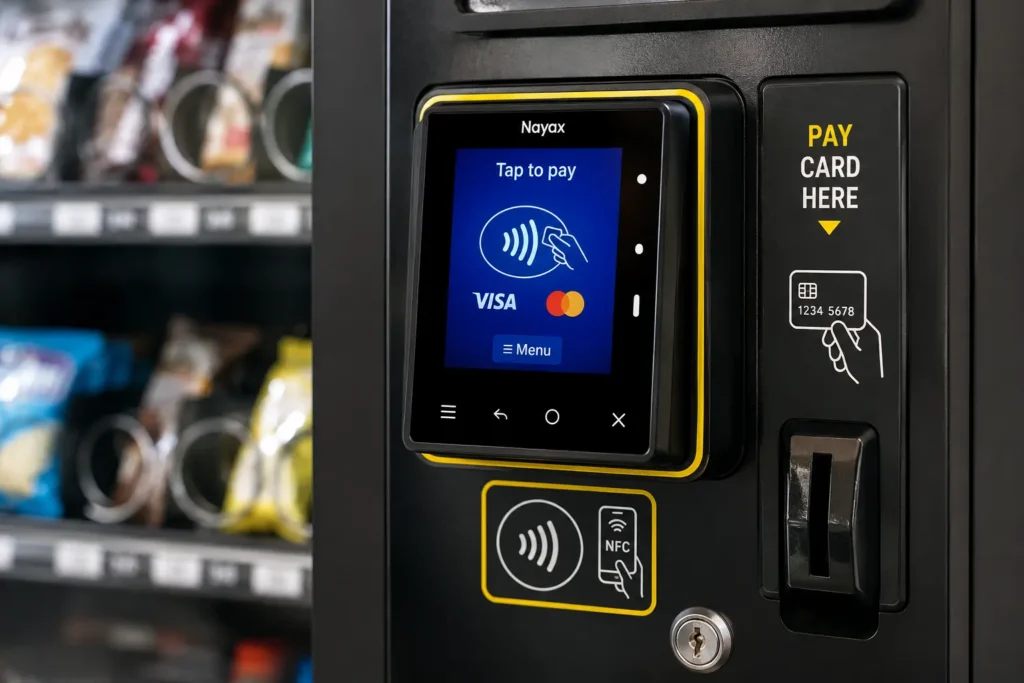
The Hidden Costs: ADA Compliance and Delivery
Many new operators forget the hidden startup costs. First is delivery. Moving a 600-pound machine requires specialized equipment like a pallet jack and a box truck. Expect to pay a local mover $150 to $300 per machine for installation.
Second is Americans with Disabilities Act (ADA) Compliance. Federal ADA regulations mandate that the operable parts of the machine (buttons, coin slots, card readers) must be positioned between 15 inches and 48 inches from the floor. If you buy an older, non-compliant machine, you could face legal liabilities or lose your location contract entirely.
How Much Does It Cost to Run a Vending Fleet? (OpEx Breakdown)
Once your machine is plugged in, your Operating Expenses (OpEx) begin. These are the recurring monthly costs that eat into your gross revenue. Understanding OpEx is crucial to determining if are vending machines a good investment for your specific financial goals.
Telemetry Systems, Interchange Fees, and Micro-Transactions
Cashless readers bring in more sales, but they are not free.
- Telemetry Subscription: Expect to pay $8 to $12 per month, per machine, for the cellular data connection that links your machine to the cloud.
- Interchange Fees (Merchant Processing): Credit card companies charge a fee for every swipe. Because vending relies on Micro-Transactions (small dollar amounts), flat fees hurt. A typical fee structure is 5.95% + $0.05 per transaction.
Example: If a customer buys a $1.50 bag of chips with a card, the processor takes about $0.14. You keep $1.36. You must factor this into your pricing strategy.
Inventory Spoilage Rates and State Department of Revenue Taxes
Inventory Spoilage Rate is the silent profit killer. If you stock fresh food or healthy snacks with short shelf lives, expect a spoilage rate of 3% to 5%. You must throw away expired food, which directly hits your bottom line.
Additionally, you must comply with your State Department of Revenue (SDR). Sales tax on vended items is notoriously complex. In some states, a bottle of water is tax-exempt, but a bottle of soda is taxed at 7%. You must configure your telemetry software to collect and remit these taxes accurately.
How Fast is the Payback Period? (A Cash Flow Velocity Case Study)
Cash Flow Velocity measures how quickly your initial investment returns to your pocket. For a high-authority financial analysis, we must calculate the Payback Period (or break-even point).
A 3-Year Break-Even Analysis on a Single Machine
Let’s look at a realistic scenario for a single, refurbished machine placed in a medium-traffic office building.
- Initial CapEx: $2,500 (Machine, card reader, delivery, and initial inventory)
Here is how the monthly math breaks down over time:
| Metric | Monthly Average | Annual Total |
| Gross Revenue | $400 | $4,800 |
| Cost of Goods Sold (COGS) | -$180 | -$2,160 |
| Credit Card Fees (OpEx) | -$20 | -$240 |
| Telemetry Fee (OpEx) | -$10 | -$120 |
| Location Commission (10%) | -$40 | -$480 |
| Net Profit | $150 | $1,800 |
At a net profit of $1,800 per year, your $2,500 investment will be fully paid back in roughly 16 to 17 months. After that point, the machine produces pure cash flow.
What Are the 2026 Tax Advantages of a Vending Business?
This is the biggest secret in the industry. For high-earning professionals, a vending business is an incredible tax shield.
Leveraging the $2.56M IRS Section 179 Deduction and MACRS
Under the Internal Revenue Service (IRS) rules for 2026, the Section 179 Deduction limit is $2.56 million. This allows you to deduct the full purchase price of qualifying equipment (like your vending machines) from your gross income in the very first year they are placed into service.
If you buy $20,000 worth of machines, you can deduct that entire $20,000 against your taxable income immediately, rather than depreciating it slowly over several years using the standard Modified Accelerated Cost Recovery System (MACRS). This dramatically lowers your end-of-year tax bill.
The 2026 Mileage Rate (72.5 Cents) and Route Deductions
Driving to your machines to restock them is a deductible expense. The IRS standard mileage rate for 2026 is 72.5 cents per mile. If you drive 100 miles a week managing your route, that equates to a $3,770 tax deduction over the course of the year. Always track your miles meticulously.
[INSERT IMAGE HERE: A person using a smartphone app to scan inventory inside an open vending machine.]
- Alt Text: Vending machine owner tracking inventory and route mileage on a smartphone app.
- Title Text: Vending Route Inventory Management
- Toggle Caption: Tracking your route mileage and inventory is essential for maximizing 2026 tax deductions.
- Creation Prompt: A medium shot of a business owner standing in front of an open snack vending machine. They are holding a smartphone, actively using an inventory tracking app. The machine is fully stocked with colorful snacks. Bright, professional office lighting. 1200x800px, 3:2 ratio.
How Do You Negotiate Profitable Location Placement Contracts?
A machine is only as good as its location. Securing prime real estate requires a legally binding Location Placement Contract.
Measuring Foot Traffic Density for “Captive Audiences”
You are looking for Foot Traffic Density and a Captive Audience—places where people are stuck for hours, like manufacturing plants, call centers, or large apartment complexes.
A general industry rule of thumb is that 1% to 2% of daily foot traffic will make a purchase. If a warehouse has 300 employees working shifts, you can reasonably project 3 to 6 vends per day.
Using Tiered Revenue-Share Commissions to Protect Margins
Property owners will often ask for a cut of your profits just for letting you plug the machine in. Never agree to a flat high percentage right away. Instead, negotiate a Tiered Revenue-Share Commission.
For example, structure your contract so that you pay 0% commission on the first $300 of monthly gross revenue, and 10% commission on anything above that. This ensures your baseline OpEx is covered before you start paying out the property owner, protecting you during slow months.
What Is the “Passive Income” Myth in the Vending Industry?
Let’s be honest: vending is not entirely passive.
Route Maintenance, Sourcing, and Restocking
Owning a vending machine requires physical labor. You must drive to bulk stores (like Costco or Sam’s Club), load heavy boxes into your vehicle, drive to the location, clean the glass, empty the coin mechanisms, and meticulously restock the coils. If a coin jam happens on a Friday night, you have to go fix it, or you lose a whole weekend of sales.
Avoiding FTC Franchise Rule Scams and Bad Route Purchases
Because the industry is popular, scammers exist. Beware of “Business Opportunity” packages that promise guaranteed locations for a massive upfront fee. Always demand disclosure documents compliant with the Federal Trade Commission (FTC) Franchise Rule. It is almost always safer and cheaper to buy your own machines and source your own locations than to buy an overpriced, pre-packaged route from a shady broker.
Pros and Cons of Starting a Vending Machine Business
To evaluate if are vending machines a good investment for you, weigh these objective factors:
The Pros:
- Low Barrier to Entry: Start with under $3,000.
- Cash Flow: Generates immediate daily revenue.
- Tax Benefits: Massive 2026 deductions via Section 179 and mileage.
- Scalability: Once you master one machine, it is easy to duplicate the process.
The Cons:
- Physical Labor: Moving boxes, driving, and machine maintenance.
- Vandalism Risk: Machines in public areas can be damaged or robbed.
- Location Churn: Businesses close or downsize, forcing you to relocate your heavy equipment.
- Spoilage: Expired food eats directly into your profit margin.
Frequently Asked Questions (FAQs) About Vending Investments
How much does an average vending machine make a month?
An average machine in a medium-traffic location generates about $300 to $500 in gross revenue per month. After deducting the cost of goods sold (COGS), credit card fees, and location commissions, the net profit is typically between $150 and $250 per month.
What is the biggest downside to owning a vending machine?
The biggest downside is the physical time commitment and the risk of location churn. If a location suddenly goes out of business or asks you to remove the machine, you are left paying to move and store a 600-pound asset until you can secure a new contract.
Is it hard to start a vending machine business from scratch?
The barrier to entry is very low—anyone can buy a machine. However, the barrier to profitability is moderate. It requires sales skills to pitch business owners for location space, and logistical discipline to manage inventory, clean machines, and track tax deductions accurately.

 By
By