


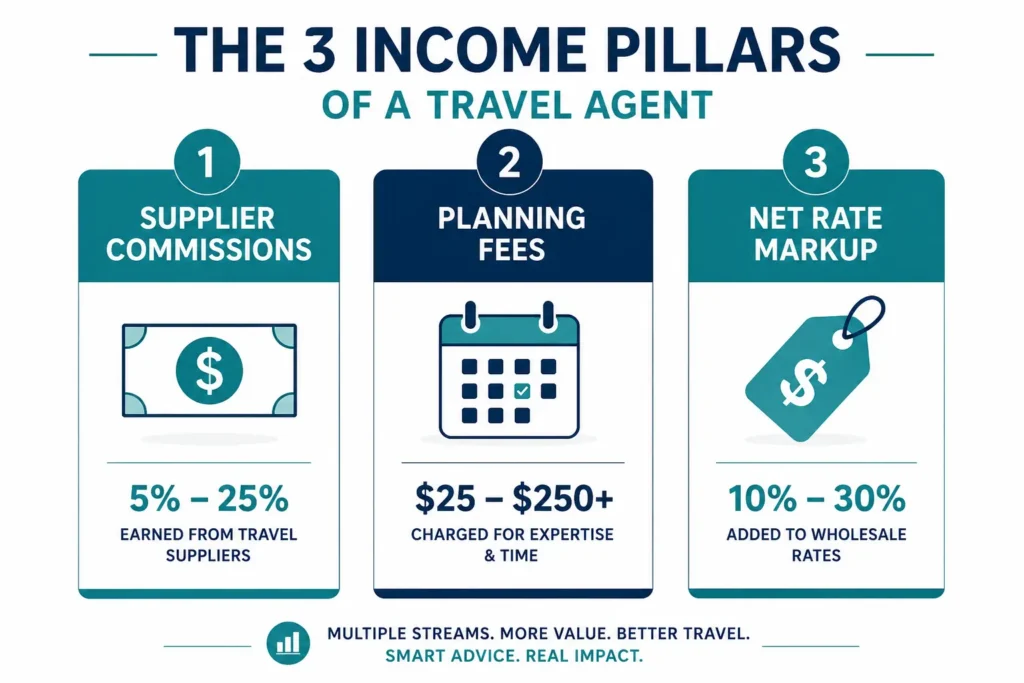
A travel agent’s income is built on three pillars: supplier commissions, professional planning fees, and net rate markups on custom packages. This guide breaks down every revenue stream, explains the hidden mechanics behind the payouts, and shows you real numbers — so you can understand exactly where the money flows.
Whether you’re thinking about becoming a travel agent or just curious how they profit while you book through them, this is the complete picture.
What Are the Primary Revenue Streams for a Travel Agent?
The primary revenue streams for a travel agent break into two categories: back-end payouts from suppliers and front-end charges paid directly by the client.
Most agents earn from both sides. Let’s start with the foundation.
Earning Supplier Commissions and Ancillary Revenue
Supplier commissions are percentage-based payments made by hotels, cruise lines, and tour operators after a trip is completed. The agent does the legwork of booking and supporting the client; the supplier rewards that referral with a commission.
Here are the 2026 benchmark rates:
| Supplier Type | Commission Range |
|---|---|
| Hotels | 10%–15% (luxury: up to 17%) |
| Cruise lines | 10%–16% |
| Tour operators | 12%–18% |
| Airlines | 0%–2% (agents typically charge a fee instead) |
| Vacation packages | 20%–30% (net rate model) |
Practical example: A family books a $6,000 cruise. The cruise line pays 12% commission = $720. If the agent works under a host agency with a 70/30 split, the agent keeps $504 from that single booking.
On top of base commissions, agents generate ancillary revenue through:
- Travel insurance: Agents typically earn 20%–30% commission on every policy sold. A $300 policy = up to $90 for the agent.
- Shore excursions and local tours: These carry higher margins because they’re less price-compared than flights or hotels.
- Car rentals and transfers: Consistent, low-effort add-ons that stack up quickly over dozens of bookings.
These “extras” are often where experienced agents quietly outperform newer ones.
Charging Professional Planning Fees Upfront
Here’s a shift that has changed the industry: over 55% of travel advisors now charge planning fees in addition to earning commissions.
Professional planning fees are non-refundable charges paid by the client at the start of the engagement — before a single hotel is booked.
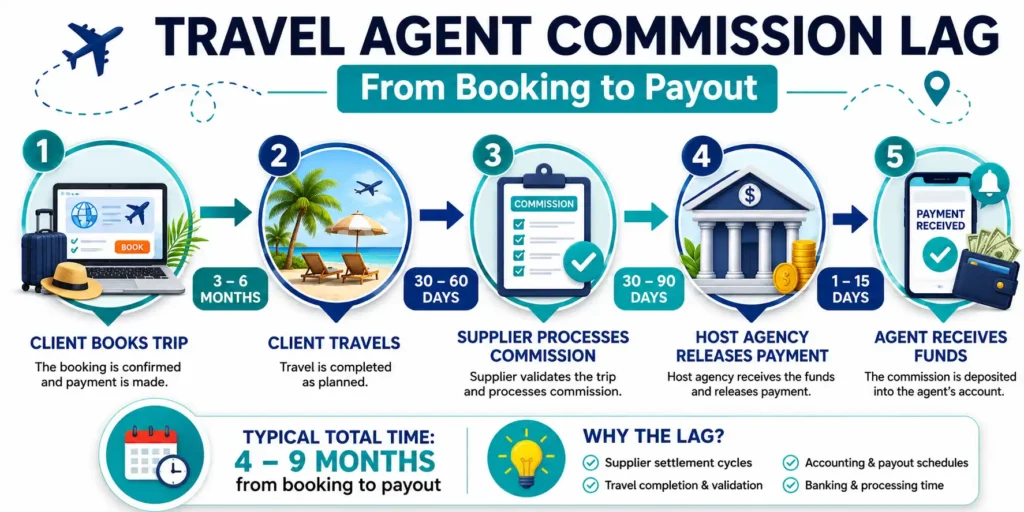
Why does this matter? Commissions are only paid after travel is completed, sometimes 30–90 days later. Planning fees protect an agent’s time and create immediate income.
Typical 2026 fee ranges:
- Simple domestic trip: $50–$150
- Complex international itinerary: $150–$500
- Group travel or destination weddings: $500–$2,500
Think of it like a retainer for a lawyer. You pay for the expertise, not just the outcome.
Important: Planning fees don’t replace commissions — they stack on top of them. A $300 planning fee + $700 in cruise commission = $1,000 earned on a single booking.
Utilizing a Net Rate Markup for Custom Tours
This is how sophisticated agents build custom packages without relying on standard retail pricing.
A net rate is an unpriced wholesale cost that a tour consolidator or destination management company (DMC) offers to registered travel agencies. The supplier does not set the final price — the agent does.
How it works:
- Agent buys a 7-day Italy tour at a wholesale net rate of $2,000 per person.
- Agent marks it up to $2,600 per person (a 30% margin).
- Client pays $2,600 and sees a professional package with added value (curated dining, private guides).
- Agent earns $600 per person — with no commission lag, because the margin is built into the price.
Vacation packages built this way typically yield 20%–30% profit margins, far exceeding the standard commission model.
How Does the Agency Structure Affect Earnings and Payouts?
Your agency structure determines how much of your gross commission you actually keep.
The Independent Contractor and the Host Agency Split
Most new travel agents don’t hang out their own shingle immediately. Instead, they join a host agency — a parent organization that provides booking software, supplier relationships, and industry credentials like IATA (International Air Transport Association) or CLIA (Cruise Lines International Association) numbers.
In exchange, the host agency takes a cut of every commission. This is the host agency split.
Common splits in 2026:
| Agent Experience | Typical Split (Agent/Host) |
|---|---|
| New agent | 70/30 |
| Established agent | 80/20 |
| High-volume producer | 90/10 |
| Independent (own accreditation) | 100/0 |
Back to the cruise example: that $720 commission at a 70/30 split means $504 goes to the agent, $216 to the host. A 90/10 split would yield the agent $648 instead.
The tradeoff is real: a 70/30 split costs money but saves years of building supplier relationships and obtaining expensive industry accreditation on your own.
Navigating the Commission Lag / Payout Cycle
Here’s what no recruitment ad will tell you: you don’t get paid when the booking happens. You get paid after the client travels — and sometimes weeks after that.
The commission lag is the gap between booking a trip and actually receiving the supplier’s payment. In 2026, this cycle typically runs 30 to 90 days post-travel.
Real-world scenario: A client books a European cruise in January for a July departure. The agent won’t see that commission until September — a nine-month wait.
This is why planning fees are so valuable. They are collected immediately, providing cash flow while commission checks are still in transit.
How Can Travel Advisors Generate Advanced Ancillary Revenue?
Once the fundamentals are mastered, high-performing agents scale income using three additional strategies.
Transitioning to the Annual Retainer Model for the MICE Segment
MICE stands for Meetings, Incentives, Conferences, and Exhibitions — the corporate travel segment.
Instead of charging per-trip fees, elite advisors serving corporate clients switch to an annual retainer model: a fixed yearly subscription (often $5,000–$20,000+) paid by a company for ongoing travel concierge services.
Benefits are significant:
- Predictable monthly income, regardless of booking volume
- Institutional relationships that generate repeat revenue year after year
- Higher average booking values (corporate accounts book business class and premium hotels)
A single corporate retainer client can be worth more than 50 individual leisure bookings.
Managing The Float and Navigating Seller of Travel (SOT) Laws
Here’s an advanced strategy that few discuss publicly: the float.
When a client pays for a custom package upfront, that money sits in the agent’s business account before it’s forwarded to suppliers. During that window — sometimes 30–60 days — a savvy agent parks those funds in a high-yield business savings account, generating passive interest income.
Example: An agent manages $500,000 in annual client deposits. At a 4.5% annual yield, the float generates roughly $9,375 per year in passive interest at zero extra effort.
However, this comes with legal responsibility. Many U.S. states require travel agents to hold client funds in a dedicated escrow trust account under Seller of Travel (SOT) laws. States with active SOT regulations include California, Florida, Hawaii, Iowa, and Washington. Violating these rules can result in fines or license revocation.
Bottom line: The float is a real income lever, but it must be managed within your state’s legal framework.
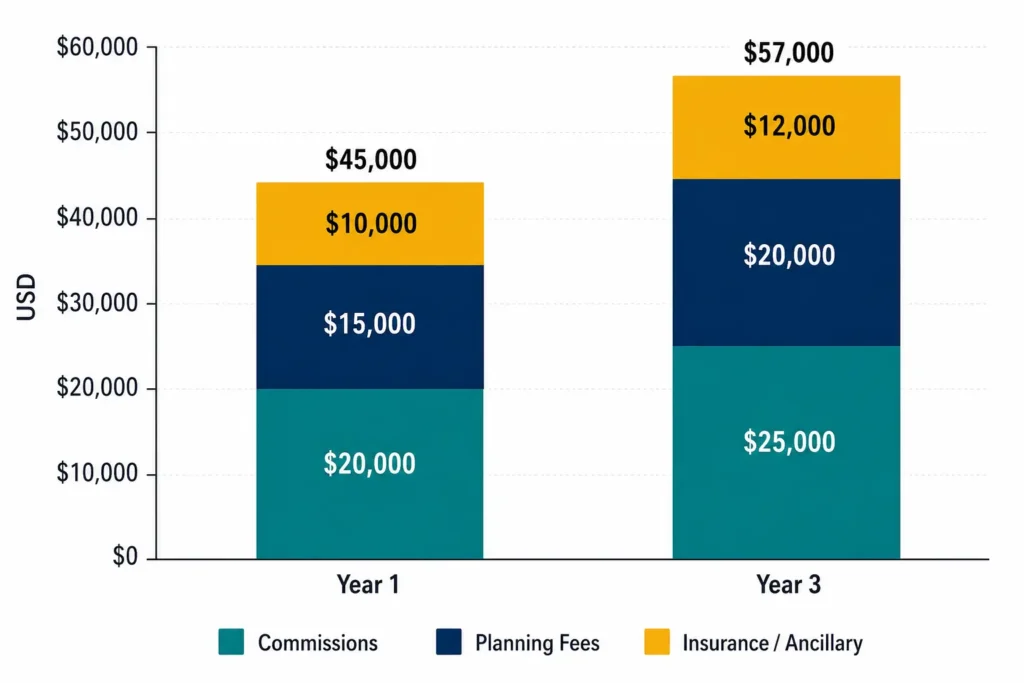
Case Study: Year 1 vs. Year 3 Earnings Simulation
Let’s make this concrete with a realistic projection for an independent contractor working through a host agency at a 70/30 split.
Assumptions:
- Average booking value: $4,000
- Commission rate: 12%
- Planning fee per booking: $150
- Year 1: 40 bookings | Year 3: 100 bookings (repeat clients + referrals)
| Metric | Year 1 | Year 3 |
|---|---|---|
| Total bookings | 40 | 100 |
| Gross commissions (12%) | $19,200 | $48,000 |
| Agent’s share (70%) | $13,440 | $33,600 |
| Planning fees collected | $6,000 | $15,000 |
| Travel insurance commissions (est.) | $2,400 | $6,000 |
| Total agent income | $21,840 | $54,600 |
Scaling Income Through Consortia Overrides
By Year 3, something powerful kicks in: consortia overrides.
A consortia is a mega-network of independent agencies that pools collective sales volume to negotiate higher supplier commission tiers. When the consortia’s total sales cross a predefined threshold, all member agents receive a bonus commission payment — the override — at year’s end.
This override can add 2%–5% on top of base commissions, paid retroactively on the year’s full volume. On $33,600 in commissions, a 3% override could add over $1,000 in passive bonus income — without booking a single additional trip.
Well-known consortia include Virtuoso, Signature Travel Network, and Travel Leaders Network.
What Are the 2026 Tax and Compliance Rules for Independent Agents?
Independent travel agents are self-employed. That changes everything about how they handle taxes.
Navigating 1099-K Reporting Thresholds and Schedule C (Form 1040)
Under the One Big Beautiful Bill Act signed into law on July 4, 2025, the IRS restored the original Form 1099-K reporting threshold: payment processors (PayPal, Stripe, Venmo, etc.) must issue a 1099-K only when a user exceeds $20,000 in gross payments AND completes more than 200 transactions in 2026.
What this means practically:
- Agents earning under $20,000 via payment platforms may not receive a 1099-K — but they still owe taxes on every dollar earned.
- All self-employment income is declared on Schedule C of Form 1040.
- Net profit is subject to self-employment tax (15.3%) on top of federal income tax.
- Also note: the 1099-NEC threshold increased to $2,000 for tax year 2026 (up from $600), meaning fewer vendors will receive paperwork — but income reporting requirements remain unchanged.
Pro tip: Set aside 25%–30% of every commission check in a separate savings account to cover quarterly estimated tax payments (due April 15, June 15, September 15, and January 15).
Deducting Familiarization (FAM) Trips Legally
One of the most-searched questions about travel agents: “Do they travel for free?”
Almost. FAM trips (Familiarization Trips) are heavily discounted or fully comped journeys organized by tourism boards and suppliers to educate agents about destinations, resorts, and cruise ships.
The IRS permits FAM trip deductions as legitimate business expenses — but only under strict conditions:
- The trip must have a documented professional itinerary (hotel inspections, supplier meetings, educational sessions)
- Personal leisure activities must be a minor portion of the trip
- The agent must maintain records connecting the trip to their business (notes, photos, meeting agendas)
If a FAM trip doubles as a personal vacation, only the business-use portion is deductible. Keep receipts and document everything.
Additional deductible expenses for travel agents include:
- Home office (if used exclusively for business)
- Professional association memberships (ASTA, CLIA)
- Software subscriptions (booking platforms, CRM tools)
- Continuing education and certifications
What Is the Technical Infrastructure Behind Travel Agent Payouts?
Behind every commission check is a system of credentials and clearinghouses most clients never see.
Processing Commissions via IATA, CLIA, and ARC Credentials
To book travel professionally and receive supplier commissions, agencies need recognized credentials:
- IATA (International Air Transport Association): The global standard for air travel bookings. An IATA number allows agencies to issue tickets and settle payments with airlines worldwide.
- CLIA (Cruise Lines International Association): The industry body for cruise bookings. A CLIA membership unlocks cruise line commission programs and FAM trip access.
- ARC (Airlines Reporting Corporation): The U.S.-based clearinghouse that settles all commercial airline ticket revenue between airlines, agencies, and agents. Every domestic airline ticket sold through a travel agent flows through ARC’s settlement system.
Most independent contractors access these credentials through their host agency rather than obtaining them individually — another core value of the host agency relationship.
Operating as the Merchant of Record (MoR) with E&O Insurance
Agents who process client credit card payments directly become the Merchant of Record (MoR) — meaning they are the legal entity responsible for that transaction.
This creates financial risk. If a supplier goes bankrupt or a booking fails, the client may dispute the charge with their card issuer — and that dispute lands on the MoR.
This is why Errors and Omissions (E&O) Insurance is essential for independent agents. E&O coverage protects the agent’s business against claims of financial loss, booking errors, or failure to deliver promised services. Annual premiums typically run $300–$800 for independent agents, depending on coverage limits.
Independent vs. Corporate Travel Agents: Pros & Cons
| Factor | Independent Agent (1099) | Corporate Agent (W-2) |
|---|---|---|
| Income ceiling | Uncapped — scales with bookings | Capped — fixed salary |
| Income floor | $0 in slow months | Guaranteed salary |
| Benefits | Self-funded | Employer-provided |
| Schedule | Fully flexible | Set hours |
| Startup cost | Host agency fees, E&O insurance | None |
| Tax complexity | High — quarterly filings | Low — employer withholds |
| Best for | Entrepreneurs, high earners | Stability-seekers, beginners |
The independent path offers higher upside but demands financial discipline. The corporate path offers stability but limits long-term earning potential.
Frequently Asked Questions About Travel Agent Income
Do you pay more if you use a travel agent?
Generally, no. Supplier commissions are built into the published price of most travel products — especially cruises and resort packages. The agent’s commission is paid by the supplier, not added to your bill. The only time clients pay extra is when an agent charges a planning fee, which is disclosed upfront. For complex international itineraries, many travelers find this fee worthwhile.
How much does a beginner travel agent realistically make in Year 1?
Based on 2026 industry data, a part-time new agent booking 40 trips per year can realistically earn $18,000–$25,000, combining commissions and planning fees. A full-time agent aggressively building a client base can target $40,000–$50,000 by the end of Year 1. Income grows significantly in Years 2 and 3 as repeat clients and referrals reduce the time spent on marketing.
Do travel agents get paid hourly or strictly by commission?
Independent contractors earn purely through commissions, fees, and markups — there is no hourly component. Corporate agents at travel management companies typically receive a base salary of $35,000–$55,000 plus small performance bonuses. Salaried agents sacrifice income upside for the security of a steady paycheck.
Conclusion
Travel agents make money through a diversified model that rewards expertise, volume, and long-term client relationships. The core streams — supplier commissions (10%–18%), professional planning fees ($50–$2,500), and net rate markups (20%–30%) — form the foundation. Advanced strategies like MICE retainers, consortia overrides, and the float separate six-figure producers from the rest.
The 2026 tax environment is cleaner than it was: the 1099-K threshold sits at $20,000/200 transactions, and FAM trips remain deductible with proper documentation. But taxes still require discipline — set aside a quarter of every commission check.
If you’re evaluating a career as a travel advisor, the income curve is real: slow in Year 1, accelerating in Year 3 and beyond. The agents who succeed treat it like a business from day one.
Want to learn more about careers in the travel and financial services industries? Explore our related guides on freelance income strategies.
Sources: IRS Fact Sheet FS-2025-08; One Big Beautiful Bill Act (July 4, 2025); MainStreet Travel Agency 2026 Commission Report; Fora Travel Cruise Agent Guide 2026; Ezus Travel Agent Income Data 2026.

 By
By