

Short on cash and staring at your Venmo balance? You’re not alone. Millions of people ask the same question every month: can you borrow money from Venmo directly? The short answer is no — but there are real ways to get cash into your account fast. This guide breaks down exactly how, what it costs, and what the IRS wants you to know in 2026.
Can You Borrow Money Directly From Venmo?
No. Venmo does not offer a native micro-lending or cash advance feature. You can’t tap a button and borrow from the app itself, the way you might with a payday loan or a bank line of credit.
Venmo is a peer-to-peer (P2P) payment app, not a lender. It moves money between people; it doesn’t create new money to lend you. If you need short-term cash, you have three realistic paths: connect a third-party cash advance app, use the Venmo Visa Credit Card, or ask a friend or family member to send you money directly.
How Do You Borrow Money Using Venmo Workarounds?
Since Venmo won’t lend you cash directly, the real question becomes: how do you get borrowed money into your Venmo balance? There are three main routes in 2026: earned wage access (EWA) apps, the Venmo Visa Credit Card, and direct P2P transfers from someone you know. (A fourth option, Visa+ interoperability, recently changed — more on that below.)
Each option trades off speed, cost, and eligibility differently. Here’s how each one actually works.
1. Connecting Earned Wage Access (EWA) Apps to Your Direct Deposit Account
Earned Wage Access (EWA) apps — think EarnIn, Dave, Brigit, or MoneyLion — let you access wages you’ve already earned but haven’t been paid yet. They’re not loans in the legal sense; you’re pulling forward your own paycheck.
Here’s the workflow:
- Link an EWA app to your primary Direct Deposit Account (DDA) — your regular checking account.
- The app verifies your work hours or pay schedule and advances a portion of your earned wages to that checking account.
- You then move those funds into Venmo using a standard ACH bank transfer (free, 1–3 business days) or an instant debit transfer (small fee, usually minutes).
Most EWA apps cap advances between $50 and $500 depending on your income history. Some charge a flat “express fee” for instant delivery (commonly $1.99–$8.99), while scheduled transfers are typically free.
2. Applying for the Venmo Visa Credit Card Issued by Synchrony Bank
The Venmo Visa Credit Card is a real credit product — a revolving line of credit issued by Synchrony Bank under a license from Visa. It’s the closest thing Venmo offers to an actual borrowing tool, since it lets you spend against a credit limit rather than your own balance.
You can use the card to fund a peer-to-peer transfer, but this gets expensive fast. Venmo charges a 3% fee any time you fund a payment with a credit card. On top of that, many card issuers — including Chase, Capital One, Bank of America, and Barclays — code P2P transfers as cash advances, not purchases. That triggers a separate cash advance fee (typically 5%, minimum $10) and a cash advance APR that starts accruing interest immediately, with no grace period. As of early 2026, the Venmo Visa Credit Card’s own cash advance APR sits around 30.74%. American Express and Discover are notable exceptions — they generally still code Venmo transactions as regular purchases.
Bottom line: funding Venmo with a credit card can mean paying two separate fees plus high interest, layered on top of each other.
3. What Happened to Visa+ Interoperability Between Venmo and PayPal
Older guides may tell you to use Visa+ to pull funds from PayPal into Venmo using a personalized “payname.” That workaround is going away. As of February 19, 2026, Visa+ no longer supports sending money between Venmo and PayPal, and new Visa+ payname sign-ups stopped in January 2026 on both platforms.
What still works: you can receive Visa+ transfers into your Venmo balance from participating earned-wage and payout partners, including Payactiv, DailyPay, eTip, and MyBambu — with no fee and delivery typically within 30 minutes, capped at $2,500 per transaction. If your goal is borrowing against wages you’ve already earned, this receiving-only channel is still live in 2026; using it to shuffle funds between two personal wallets is not.
What Are the Total Costs and Fees of Venmo Borrowing Methods?
The real cost of “borrowing” through Venmo depends entirely on which workaround you pick and how fast you need the cash. Here’s the 2026 fee landscape:
- Standard ACH bank transfer: $0, arrives in 1–3 business days.
- Venmo Instant Transfer: 1.75% of the amount, minimum $0.25, maximum $25 — usually arrives within 30 minutes.
- Funding a payment with a credit card: 3% Venmo fee, plus a possible cash advance fee (around 5%, minimum $10) and immediate interest from your card issuer.
- EWA app express fees: typically $1.99–$8.99 for instant delivery; often free for scheduled 1–3 day delivery.
Case Study: The True Cost of a $500 Emergency Cash Advance
Numbers make this easier to picture. Say you need $500 fast for a car repair.
You use an EWA app with an $8.99 express fee to move $500 into your checking account instantly. Then you pull that $500 into Venmo using Instant Transfer, which charges 1.75% — that’s $8.75 on $500.
Total cost: $17.74 to access $500 immediately — an effective short-term fee of about 3.55%, before counting any interest if the underlying advance itself carries a finance charge.
| Method | Fee Structure | Total Cost on $500 | Wait Time |
|---|---|---|---|
| Option A: EWA app + standard ACH transfer | 0% | $0.00 | ~2 days |
| Option B: EWA app + Venmo Instant Transfer | 1.75% (Venmo) + flat express fee | ~$17.74 | Instant |
| Option C: Credit card P2P transfer | 3% (Venmo) + 5% cash advance fee + APR from day one | $40+ and rising with interest | Instant |
Comparing Venmo Liquidity Options: Fees, Speed, and Risk
Quick reference for picking the right option:
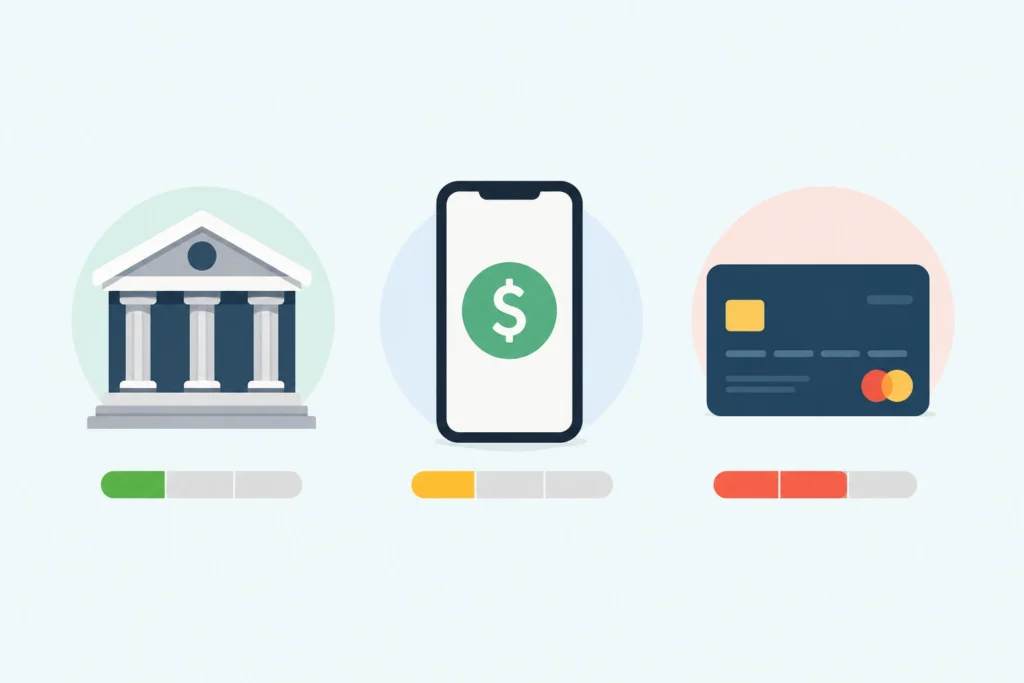
- EWA apps (EarnIn, Dave, Brigit): Low fees ($0–$10) | Speed: 1–3 days or instant | Credit impact: none.
- Venmo Credit Card: High fees (cash advance APR + 3% Venmo fee) | Speed: instant | Credit impact: hard inquiry, raises credit utilization.
- Credit card P2P transfer (other issuers): Very high fees (8%+ combined) | Speed: instant | Credit impact: high utilization, immediate interest.
- P2P transfer from family or friends: $0 fees | Speed: instant | Credit impact: none.
If you have someone willing to send you money directly with no repayment pressure, that’s the cheapest route by far. Everything else on this list involves a fee, an interest charge, or both.
How Do 2026 IRS Form 1099-K Tax Rules Impact Borrowed Venmo Funds?
Here’s where a lot of outdated articles get it wrong. For years, the IRS threatened to drop the reporting threshold for Form 1099-K down to just $600. That never fully happened. The One Big Beautiful Bill Act (OBBBA), signed into law in July 2025, permanently restored the original threshold: platforms like Venmo only issue a 1099-K when a user receives more than $20,000 and more than 200 transactions in goods and services payments in a calendar year. Read the official IRS guidance on Form 1099-K reporting for the current federal rules.
That threshold applies only to commercial transactions — money you receive for selling something or providing a service. Personal transfers, including money borrowed from friends or family, are not taxable and are not reported, no matter how large the amount, as long as the payment is correctly categorized. A handful of states set their own, lower reporting thresholds, so check your state’s rule if you’re close to any limit.
Using the Goods and Services Toggle to Prevent Tax Misreporting
Venmo has a setting called Goods and Services that classifies a payment as a commercial purchase rather than a personal transfer. It matters here because if a friend accidentally toggles it on when sending you borrowed cash, Venmo may treat that transfer as business income — and it could eventually count toward your 1099-K total.
To keep a personal loan from friends or family clearly non-taxable:
- Ask the sender to select “Friends and Family” or leave Goods and Services off.
- Add a short note like “loan repayment” for your own records.
- Avoid using Goods and Services toggles for personal loans even if the sender wants purchase protection — it’s designed for buying items, not borrowing cash.

What Financial Consumer Protections Apply to Money Held in Digital Wallets?
Before you route borrowed money through Venmo, it’s worth understanding what protections do — and don’t — apply to that balance.
Money sitting in your Venmo balance is not automatically insured by the FDIC the way a bank deposit is. The Consumer Financial Protection Bureau (CFPB) has previously warned that funds stored in digital payment apps can lack the same federal protections as a traditional bank or credit union account, unless the provider has structured the funds to receive “pass-through” insurance through a partner bank. It’s worth noting the regulatory picture around nonbank payment apps has shifted: Congress repealed a 2024 CFPB rule that would have given the agency direct supervisory authority over large digital wallet providers like Venmo and PayPal, and the CFPB’s own funding and enforcement capacity has been reduced heading into 2026. That means less proactive federal oversight of wallet balances than existed just two years ago — one more reason to avoid parking large sums of borrowed money in a Venmo balance longer than necessary.
Credit products are a different story. The Venmo Visa Credit Card, because it’s issued by a chartered bank (Synchrony), remains subject to standard credit protections under the Truth in Lending Act (TILA), including required APR and fee disclosures. Review the CFPB’s consumer guidance on payment apps for more on how these protections work.
Practical takeaway: move borrowed funds out of your Venmo balance and into an FDIC-insured bank account once you no longer need them for immediate spending.
Frequently Asked Questions About Borrowing Money on Venmo
Can you get a cash advance on Venmo without a credit card?
Yes. Link an Earned Wage Access app, like EarnIn or Dave, to your bank account, let it advance a portion of your paycheck, then transfer those funds into Venmo through a standard ACH transfer or an instant debit transfer. No credit card is required.
How do you overdraw a Venmo balance to get immediate cash?
You can’t. Venmo doesn’t allow you to intentionally overdraw your balance. If a payment exceeds what’s available, Venmo automatically pulls the difference from your designated Backup Payment Source — usually a linked bank account or debit card — instead of letting the balance go negative.
Does borrowing money using Venmo workarounds affect your credit score?
It depends on the method. Personal P2P transfers and EWA advances typically don’t affect your credit score at all. Applying for the Venmo Visa Credit Card, on the other hand, triggers a hard credit inquiry and changes your credit utilization — both of which can move your score.

 By
By